
Purple Nutsedge

Related Articles
- Calcium and Magnesium For Mississippi Crops 1
- March 11 Precision Agriculture Workshop 0
- Ground Speed Affects Spray Droplet Deposition 0
Latest Tweets
Purple Nutsedge
Weed Flora of Mississippi
Family: Cyperaceae
Genus: Cyperus Species: rotundus
History: Native to Africa, southern and central Europe (north to France and Austria), and southern Asia. The word Cyperus derives from the Greek and rotundus is from Latin, meaning “round”. Purple nutsedge is one of the most invasive weed species, spread out to a worldwide distribution in tropical and temperate regions. It has been called “the world’s worst weed” as it is known as a weed in over 90 countries and infests over 50 crops worldwide.
Life Cycle: Perennial
Special Characteristics: Purple nutsedge initiates its seasonal growth cycle almost entirely from tubers, as viable seeds rarely occur in this species. Tuber dormancy is broken by high temperature (90 to 100 °F) and diurnal temperature fluctuations. Like most C4 plants, purple nutsedge is shade intolerant, and can be suppressed by a closed crop canopy, although tubers remain viable and send up new shoots when the canopy is removed.
Purple nutsedge is one of the most extensively researched noncultivated plant species, yet the complexities of its life cycle, and its multiple adaptations to environmental extremes and weed control tactics are incompletely understood. Tuber and rhizome production are important factors in this species’ success as a weed. Rhizomes provide the major means by which the plants may colonize an area. Tubers offer a mechanism for asexual reproduction, and they are the major dispersal units that can survive extreme conditions. The root system in heavy clay may extend more than a meter deep. Purple nutsedge is allelopathic and removes nutrients from soil and its existence in a field significantly reduces crop yield. It is resistant to most herbicides and is one of the few weeds that cannot be stopped with plastic mulch.
Roots: It has fibrous roots. Rhizomes and tubers occur on the same plants. Tubers are oblong, ridged, initially white in color, eventually turning brown or black, and are bitter to the taste.
Stem: Erect, unbranched, and three-sided and triangular cross-section.
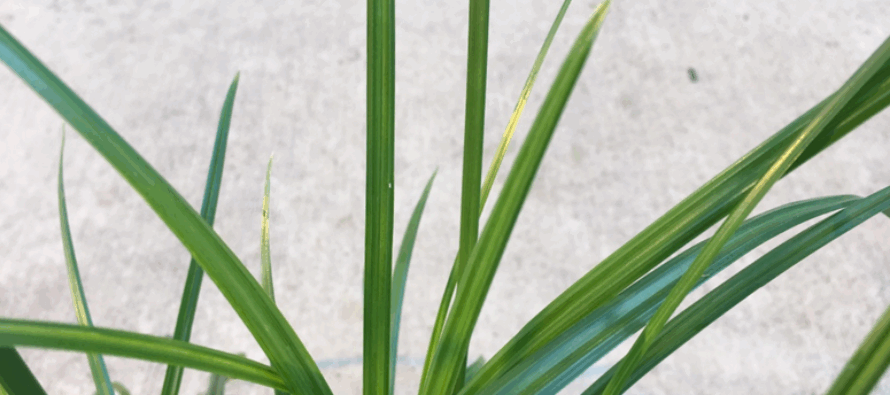
Leaves: Dark green and have a distinctly shiny appearance. Leaves are produced in groups of three from the base of the plant. The leaves sprout in ranks of three from the base of the plant, around 2 to 8 in long.
Flower: Near the ends are clusters of narrow spikelets, 0.3 to 1 in long and 0.07 in wide, 10- to 40-flowered, acute and compressed with a red, reddish-brown, or purplish-brown color.
The flower is bisexual and has three stamina and a three-stigma pistil, with the inflorescence having three to eight unequal spikes.
Seeds / Fruit: The fruit is a three-angled achene.
Interference: Purple nutsedge competes vigorously against most crops for soil moisture and nutrients, and against low growing or slow-starting crops for light. It is especially competitive during warm seasons with ample moisture, and becomes less so in cooler, drier conditions. Purple nutsedge has become a major weed of vegetables, row, and plantation crops in tropical and warm temperate climates around the world, is very difficult to manage with either organic or conventional weed control strategies.





Let me tell You a sad story ! There are no comments yet, but You can be first one to comment this article.
Write a comment