
The R3/R4 Fungicide Application: Reconsidering the Practice from Large-plot Strip Trial Data


Related Articles
- 2010 Soybean And Corn Variety Trial Data 3
- Rice Variety Trial Results For 2010, Plus Rice Research Report 0
- Evaluation of Peanut Prescription Rx Program in Mississippi 0
Latest Tweets
Considering an R3/R4 fungicide application in 2026? You might want to reconsider that input based on the more current data set as well as the economic climate. Historically, MSU Extension suggested making a fungicide application at R3/R4 based on a large data set that considered several specific field-level characteristics based on years of data from commercial soybean fields. High-yield environments, which consisted of early-planted maturity group IV soybean varieties in a continuous soybean system with irrigation were considered to be the locations that generally benefited most from an “automatic” foliar fungicide application of a QoI fungicide. However, that particular dataset generally suggested that application was beneficial approximately 55-60% of the time. Since the initiation of some of those trials dating back to the early 2000s, many have thought that application produced a guaranteed positive benefit (or ROI) in every field situation and would result in a positive economic gain every time. Making a foliar fungicide application to soybean and expecting a positive response, that would pay for the fungicide product and the method of application (approximate costs for either ground ($3/A) or aerial (>$7/A)) and put money in your pocket, does not occur every time (more on that below).
Large plot strip trials (n=18 locations), funded by the MS Soybean Promotion Board, were conducted between 2018 and 2023. The strip trials were non-replicated in commercial soybean fields and much larger than what is normally conducted in small-plot replicated trials (e.g., 900 foot in length to several acres). Trials were conducted at non-irrigated locations (n=4) and irrigated locations (n=14). Non-treated strips were included at all locations for the sake of comparison. Locations considered either two or sometimes as many as four different fungicide products. Data were evaluated and comparisons made between the treated and non-treated strips at each location so that data could be presented as a difference (positive or negative). The specific fungicides used differed by year and in all nine products or tank mix applications were considered. Fungicides were all applied with a non-ionic surfactant (NIS). The products considered included: Aproach Prima, Lucento, Magistrate, Miravis Top, Priaxor D (a tank mix of Priaxor and propiconazole which is sold as a co-pack), Quadris Top SBX, Revytek, Satori + Monsoon (a tank mix of generic azoxystrobin and generic tebuconazole), and Trevo TRZ. In some cases, a fungicide product or tank mix was used in a single year, or in one instance (Priaxor D), the fungicide was used at a single location in a single year.
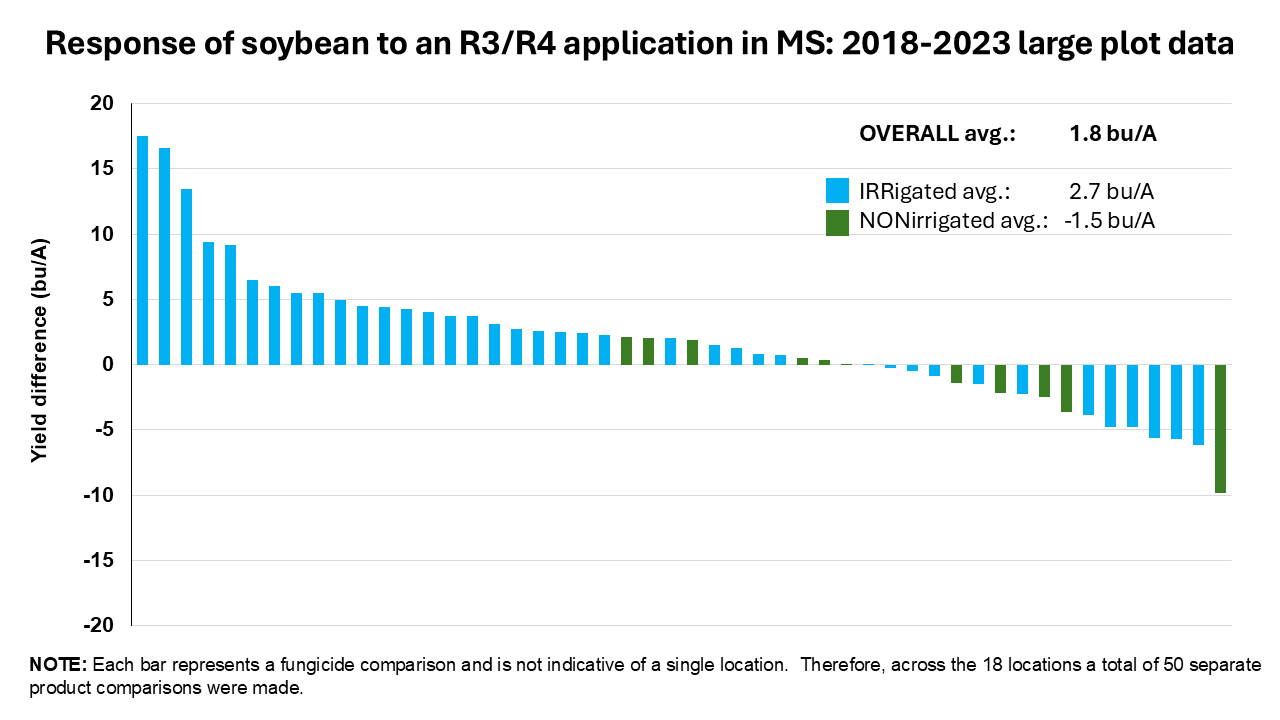
All said, at the 18 locations, a total of 50 fungicide comparisons were made and are presented in the attached figure with each bar representing a single fungicide evaluation and presented as the difference between the treated and non-treated. Data are therefore presented as a general classification of “fungicide” and not by product given that a large number of different fungicide products can be applied at R3/R4. In general, yield data varied by location and year. However, averaged across all locations an automatic fungicide application resulted in a 1.8 bu/A advantage compared to the non-treated. Averages are also presented for the irrigated locations (blue bars, avg. = 2.7 bu/A) and the non-irrigated locations (green bars, avg. = -1.5 bu/A) and present a perspective similar to the historical application practices, which suggested that irrigated locations were most likely to see a benefit from a fungicide application. Please note that the variation in yield response resulted in a large yield benefit (13-17 bu/A) in only a few instances at a single location in 2022 (one location in one year); however, there were some locations whereby a large reduction in yield was captured resulting in as much as a -9.8 bu/A difference. Large yield reductions were recorded at more than one location and in more than one year (2018, 2019, and 2020). Making a fungicide application in the absence of a yield-limiting fungal disease does not guarantee a positive return in yield.
Fungicides are important tools for row crop farmers. However, overuse of fungicides or even making fungicide applications to field situations where a major yield-limiting disease does not occur can result in the increased likelihood of fungicide resistance developing within populations of organisms that are not generally considered to be yield-limiting (e.g., Septoria brown spot). Given the widespread nature of fungicide resistance that has previously been documented in MS within the fungal populations responsible for frogeye leaf spot and target spot we should be more cautious when making fungicide applications and generally consider using fungicides in situations as a “last resort” to manage important yield-limiting diseases.




Is the referenced data chart available for viewing?