
Fungicide Phytotoxicity and Soybean Response to Fungicide Products that Cause Phytotoxicity

Related Articles
- 2010 Soybean And Corn Variety Trial Data 3
- Rice Variety Trial Results For 2010, Plus Rice Research Report 0
- Evaluation of Peanut Prescription Rx Program in Mississippi 0
Latest Tweets

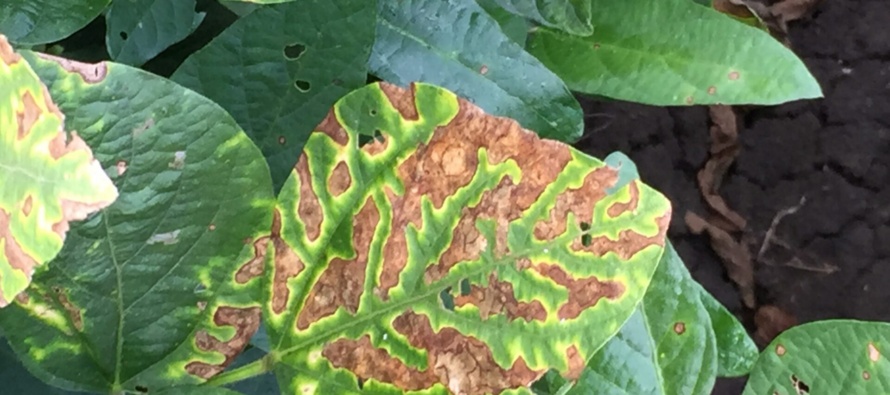
Phytotoxic response on a soybean leaf following the application of a fungicide that contained a demethylation inhibitor (DMI; or triazole).
Some fungicide products can produce an injury to the foliage of soybean plants following application, especially when applications are made during reproductive growth stages even as late as R5.5. Several terms can be used for this phenomenon: burn, injury, phytotoxicity, triazole injury, tebuconazole-associated injury, or what Bayer has most recently called the “dapple effect” following applications of Delaro and Delaro Complete. In general, the injury, can be observed as early as 10 days post-application but increases in severity between 21 and 28 days post-application. Notably, fungicides in the demethylation inhibitor class (DMI; FRAC code 3; or triazoles) are the main “culprits”; however, there can be some injury associated with applications of chlorothalonil or thiophanate-methyl or products that contain those two active ingredients. Even though the injury does occur following applications of these specific products, the appearance of phytotoxicity can be more pronounced on some varieties as compared to others. Lastly, in some cases, the foliar injury observed can be confused with some root-associated diseases (e.g., sudden death syndrome (SDS), or taproot decline (TRD)). Make note of foliar fungicide applications and pay attention to the presence of symptoms. Generally speaking, plant diseases such as SDS do not occur on several thousand contiguous acres and over the years I have had repeated calls related to fungicide injury observed on thousands of acres that was confused with something like SDS. The symptom expression in the upper foliage can be confusing if you aren’t aware that a fungicide that contains one of the active ingredients that causes phytotoxicity was applied.
Any fungicide that contains a DMI can generally produce either a mild level of phytotoxicity (a 1 in the attached table) or what I have observed to be a rather severe level of phytotoxicity (a 5 in the attached table). However, to date I have only observed what I would consider to be severe phytotoxicity with a single active ingredient (prothioconazole). The table includes products that I have evaluated in Stoneville over the past decade that produce some form of injury as either mild, moderate, or severe. Be mindful that there are multiple generics available of some of these specific fungicides on the market for active ingredients such as propiconazole (e.g., Fitness, Propicon EC) or tebuconazole (e.g., Felcura 3.6F, Onset 3.6L). However, I would expect the level of phytotoxicity regardless of product manufacturer to be the same.
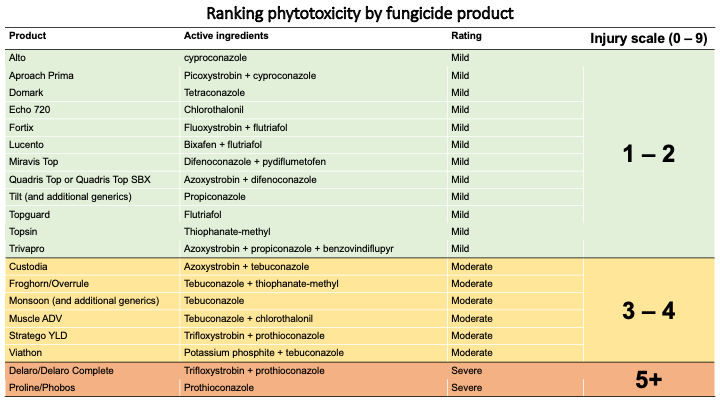
Over the past several years some new fungicide products have been released that are now commercially available. Moreover, some active ingredients have been released on the generic market and made their way into several products. One of those that I will point out is prothioconazole. Prothioconazole is a DMI and was most often recognized as the stand-alone active ingredient in Proline (from Bayer), in a pre-mix with the QoI trifloxystrobin (Stratego YLD), and more recently contained in Delaro and Delaro Complete. However, this particular active ingredient is now available on the generic market and has been included in several additional pre-mix products (n=6) in general with a QoI (azoxystrobin or trifloxystrobin) as well as several additional commercially available stand-alone fungicide products (n=4). In the testing I have done with prothioconazole since the early 2010s I can state that the active ingredient is outstanding on things like frogeye leaf spot; however, the injury with this active ingredient can be rather severe whether applied on its own or even in some pre-mix products depending on the percentage of active ingredient contained in the product. Looking at the included table where the fungicides are ranked on the order of 0-9 some might question why Stratego YLD is ranked as producing less injury than Delaro and Delaro Complete. The percent active ingredient of prothioconazole contained in Stratego YLD (10.8% prothioconazole) is lower than what is contained in Delaro (16% prothioconazole) and Delaro Complete (14.9% prothioconazole). By increasing the percent ai of prothioconazole contained in the fungicide product the corresponding injury associated with the application increased. Recently, I have heard at least one company claim that they had a formulation of prothioconazole available that does not injure soybean. I tested that product in 2025, and observed just as much injury as I would have expected with Proline. Be mindful that products that contain prothioconazole can result in a lot of phytotoxicity regardless of if they are a stand-alone fungicide or a pre-mix formulation.
Note, mixing any foliar fungicide with a herbicide is not generally something that we have considered. First and foremost, as with any pesticide, follow the label instructions when tank mixing. I only mention this topic because I have had a few conversations about intentions to make herbicide plus fungicide tank mix applications to reduce the number of field passes. Over the years, here is what I have learned that should help if this type of tank mix is going to be made:
1) be careful adding additional adjuvant and remember that herbicides such as RoundUp generally come “loaded” and already contain adjuvant;
2) be mindful that in stressed areas of the field (e.g., drought stress) that injury following a fungicide application and more specifically herbicide plus fungicide can be more pronounced in stressed areas of the field;
3) recognize that phytotoxicity following a fungicide application can begin to be observed as early as 10 days post-application, but this will increase over time and appear worse by the time you are 28 days post-application.
In closing, I suspect there may be some additional products that can result in injury to soybean. In addition, observations presented in this post are related to those in Mississippi and this may differ in other parts of the soybean production system throughout the U.S. I have only included fungicide products that I have tested/observed in the associated table and will included additional products as I consider them in efficacy plots. In my experience, so long as the product is labeled to be applied to soybean I have not observed a yield penalty from the phytotoxicity.




Is the data table available?