
Corn Disease Update: July 4, 2026

Related Articles
- 2010 Soybean And Corn Variety Trial Data 3
- Rice Variety Trial Results For 2010, Plus Rice Research Report 0
- Evaluation of Peanut Prescription Rx Program in Mississippi 0
Latest Tweets
As we reach this point in the season, several weeks after tassel, and as corn moves through some of the more important developmental stages we generally start to see more in the way of foliar diseases. Much of what we have observed over the past several weeks is nothing to worry about. As it stands, there are a limited number of fields with diseases that could be of concern. In general, once you reach tassel and beyond, much of what we see below the ear leaf can generally be ignored. However, there are some important diseases to keep in mind when scouting corn fields for plant diseases. In addition, put quite simply, diseases of corn foliage tend to increase late in the season as the crop matures…..this is normal.
Northern corn leaf blight (NCLB)

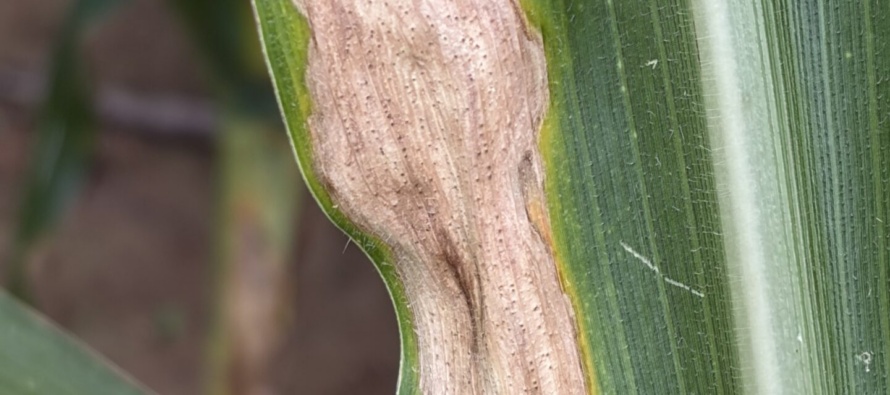
NCLB lesions on a corn leaf. Note the lack of yellow margin.
Over the past several weeks I have received quite a few texts with images of what scouts called NCLB based on the general appearance of the lesions. In most cases, drought stress, heat stress, sun scald, and even some additional diseases (outlined below) can oftentimes be confused for NCLB. The most commonly observed NCLB lesions tend to be not much longer than 2” in length, the middle is wider than the ends, and these look more like cigar-shaped lesions. However, in the cases where I have observed NCLB this year I would say lesions are a bit “longer” than normal, with some approaching 4” in length. Confirming the presence of sporulation in the lesions rather than pycnidia (see Diplodia below) is the best way to tell NCLB from some of the look-alike situations that may occur. A yellow halo is not one of the symptoms associated with NCLB lesions. In situations where the lesions have matured the leaf tissue inside the lesion oftentimes tears. Sporulation from the fungus that causes NCLB can be observed inside lesions with a 20x hand lens and tend to look like grey spikes (or trees) with an elongated football at the end of the spike. The elongated football is in fact the spore of the fungus that causes NCLB. Fields at dent that begin to present NCLB should be considered out of danger from this particular disease. In addition, in the years I have been in Stoneville I have only observed three total fields that had enough NCLB to make me consider suggesting a fungicide application. Management alternatives for 2027 to reduce the likelihood of this disease include tillage to breakdown and bury residue, and rotation.
Diplodia leaf streak

Diplodia leaf streak showing the slight yellow halo and pycnidia (pepper grains) embedded in leaf tissue.
Oftentimes, the foliar diseases caused by species of Diplodia can ben easily confused with NCLB. The general size and shape of the lesion on the leaf tissue tend to be in a similar range as NCLB and in some cases the shape of the lesions can make them easily confused with NCLB. Lesions caused by Diplodia vary in size from on the small side, something less than 0.5” in length, to some of the more commonly observed lesions that tend to be 3” in length and surrounded by a yellow halo or margin. However, keep in mind that there are also uncommon lesions associated with Diplodia diseases that can measure more than 12” in length and in some cases reach lengths of 18”. However, I have only observed lesions that measured 18” two times in my career and in a rather limited geography in MS. The best way to distinguish Diplodia from NCLB is the more regular occurrence of yellow halos around the edge of lesions and the presence of pycnidia within lesions that at times can be more easily observed on the bottom of the leaf. Be mindful that a lot of what we have seen on corn leaves this year that mimics “lesions” has had something to do with a limited amount of nutrient stress as well as heat stress. “Lesions” that tend to begin on leaf margins or at the tips of leaves are not normally associated with plant diseases. In general, Diplodia leaf diseases are not ones to be concerned about and more often than not occur and do not expand, progress, or tend to infect additional leaf tissue. Over the past several years I have observed a greater frequency of Diplodia leaf diseases than in the first decade of my career.
Crown rot
For the third consecutive year I have observed several fields with what I would call a “crown rot”. During 2026 I would say the incidence of crown rot in MS has increased from what I observed in 2024 and I have had more conversations with people that have observed similar symptoms to what I describe below. I’m not at a place where I can tell you the specific organisms involved in our production

Corn plants exhibiting symptoms of crown rot (the grey plant and the brown, dried out plant).
system, but I can tell you about the general symptoms and how those manifest themselves. Plants at first turn grey and begin to dry down, or “mature” prematurely. Leaf tissue will look dried out and the whole plant collapses, turning brown while plants that are in close proximity on the same row. The best way to describe these plants is they develop a rapid wilting as the plant succumbs to the rotting vascular tissues that can be observed inside the crown. In fields that exhibit this issue the plants are easily observed when walking down the row and plants are not necessarily be on the field edge. Plants carefully dug up and out of the soil may weigh less than healthy plants, but this will depend on how far along symptoms have progressed in the field. Careful inspection of the roots and splitting the main stem of the corn plant down the middle will show a rotted, brown internal plant tissue. The internal part of the rotted crown will generally appear brown and mushy once you cut through the plant stem. Both bacterial and fungal organisms can cause a crown rot in corn. At this time, the specific organism causing these issues in Mississippi is unknown. However, plants have been collected for analysis and culture plating in the laboratory.
Since 2024 I have observed this disease from south of Grace to Water Valley, in fields with all sorts of cropping histories. My suggestion going forward would be to bury residue with tillage and rotate out of corn for 2027 to reduce the likelihood of this disease from occurring again.
Purple leaf sheath (or yeast spot)
In the past, I have observed a lot of purple leaf sheath in the upper canopy (ear leaf and above). In general, lesions form along the main

Symptoms of purple leaf sheath (or yeast spot) at the base of a corn plant.
stalk and up against the area where the leaf whorl attached to the main stalk (or is wrapped around the main stalk). However, over the past several years I have started to see purple leaf sheath at the base of the corn plant, around the crown of the plant not far from the soil line. However, the organisms that cause this do not penetrate the stalk. If you remove the outer leaf from around the stalk you’ll see that the discoloration does not penetrate the stalk itself. Over the past several weeks I have had numerous questions and calls related to purple leaf sheath (which is not problematic) looking like banded leaf sheath (which can be problematic) which is caused by the same fungus that causes sheath blight in rice, Rhizoctonia solani. However, after collecting several leaves from plants exhibiting these symptoms I have not observed Rhizoctonia and am calling everything I’ve seen this year to be purple leaf sheath. In some cases, it will appear that this malady will “move up the plant”, but I think that’s just the saprophytic organisms producing more stain on the plant and not something to be concerned about. Clearly, some of the hybrids we are planting currently are a bit more sensitive to this particular situation than what we have observed in the past. Normally, purple leaf sheath just makes a small discoloration around the leaf whorls, generally higher in the canopy than what we are observing this season in the lower canopy.




Let me tell You a sad story ! There are no comments yet, but You can be first one to comment this article.
Write a comment