
July WASDE Highlights Tighter Rice Supplies

Related Articles
- Calcium and Magnesium For Mississippi Crops 1
- March 11 Precision Agriculture Workshop 0
- Ground Speed Affects Spray Droplet Deposition 1
Latest Tweets
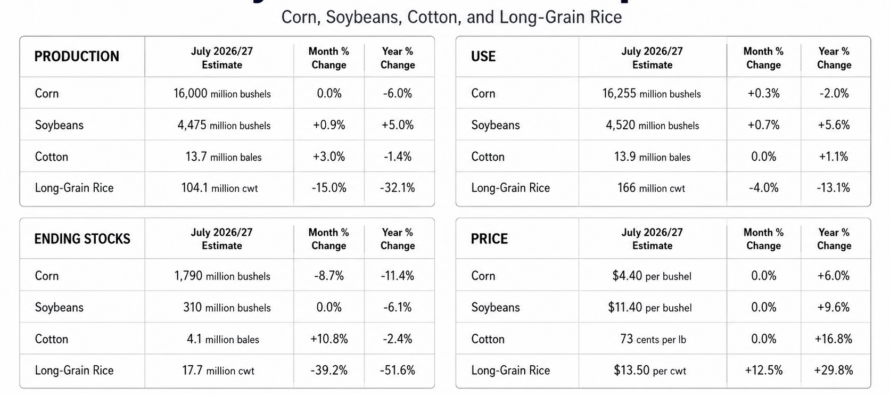
The July 2026 World Agricultural Supply and Demand Estimates report was released on Friday, July 10. Overall, the report was modestly supportive of corn and soybean prices, strongly supportive of long-grain rice prices, and slightly bearish for cotton. The full report is available at wasde0726.pdf, and the table below summarizes several of the key estimates and revisions.
Long-grain rice experienced the largest revision from the previous month, with production lowered 15 percent to 104.1 million cwt. The reduction was driven by lower planted acreage reported in USDA’s June 30 Acreage report. Total U.S. rice acreage is now estimated at 2.02 million acres, down from the 2.32 million acres used in the June WASDE. Long-grain rice production is also projected to be 32 percent below last year.
Ending stocks were lowered to 17.7 million cwt, a 39 percent decline from the June estimate and more than 50 percent below last year. Overall, the tighter supply outlook is strongly supportive of long-grain rice prices, prompting USDA to raise its projected marketing-year average price by $1.50 to $13.50 per cwt.
Cotton ending stocks increased 11 percent from the previous month to 4.1 million bales. The increase was driven by higher planted acreage and a modest increase in expected yield. Planted acreage was raised to 9.85 million acres, while the national average yield estimate increased from 866 to 872 pounds per acre. As a result, cotton production was raised to 13.7 million bales. Cotton use was unchanged at 13.9 million bales, and USDA maintained its projected marketing-year average price at 73 cents per pound.
Corn saw positive revisions to ending stocks in the July WASDE. Corn production was unchanged, but total supply was reduced slightly because of lower beginning stocks. Exports were the only corn use category revised upward, increasing to 3.2 billion bushels. Together, these changes lowered projected corn ending stocks to 1.79 billion bushels, down 170 million bushels from the previous month.
Soybean production was raised, but the additional supply was offset by stronger projected exports. As a result, projected soybean ending stocks remained unchanged at 310 million bushels.





Let me tell You a sad story ! There are no comments yet, but You can be first one to comment this article.
Write a comment