
Does Time of Day Affect Stink Bug Scouting in Soybeans?

Related Articles
- 2010 Soybean And Corn Variety Trial Data 3
- Mississippi Cotton Insect Situation of 2010: A Look Back 3
- Rice Insecticidal Seed Treatment Recommendations for Mississippi in 2011 0
Latest Tweets
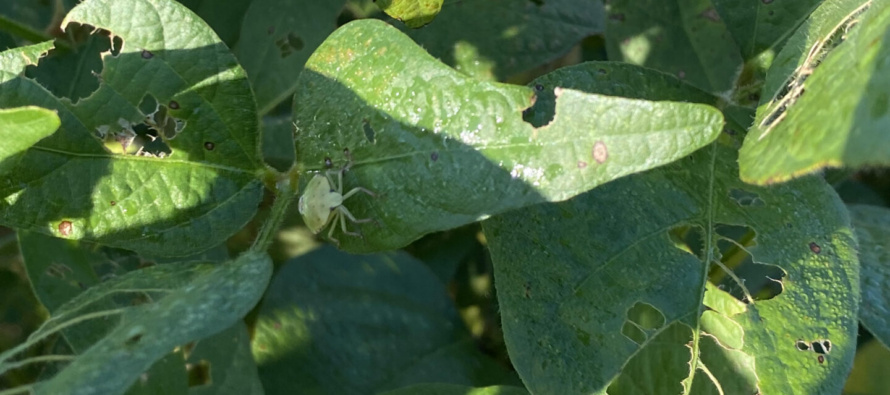
Trials were conducted across the Midsouth to address this question. Across all locations, sweep net samples collected at 7 A.M. captured 34% more stink bugs than samples collected at 4 P.M. Total captures declined from 9.2 stink bugs per 25 sweeps at 7 A.M. to 6.1 stink bugs at 4 P.M. This reduction was driven almost entirely by nymphs, which declined from 4.4 to 2.0 nymphs per 25 sweeps. Adult captures remained relatively constant throughout the day. I speculate that this is largely temperature-driven, as nymphs “bask” in the soybean canopy during cooler morning hours.
Drop cloth sampling was unaffected by sampling time, providing consistent estimates of adult, nymph, and total stink bug populations throughout the day.
A good comprehensive monitoring plan would include using sweep nets during the morning and shifting to drop cloths later in the afternoon, at least on threshold-borderline fields. One of the surprising findings during this study was that oftentimes, threshold-level stink bug infestations were underrepresented late in the afternoon.
Another aspect of this study looked at how stink bug densities changed across soybean growth stages. In season-long untreated plots, total populations increased nearly five-fold between R5 (2.4 stink bugs per 25 sweeps) and R7 (11.6 stink bugs per 25 sweeps), with similar trends observed using drop cloth sampling. Nymph populations increased rapidly beginning at R6, while adult populations peaked during R6.5 and R7.
Species composition also shifted during the season. Brown stink bugs were more common early, green stink bugs (Green and Southern Green) remained relatively stable, and redbanded stink bugs became increasingly abundant during R6.5 and R7. Continued scouting during late reproductive stages is especially important to preserve yield and grain quality where redbanded stink bugs are established.
Scouting Recommendations
- R5: Adult stink bugs are most common. Routine scouting using either method performs well.
- R6: Increase scouting frequency. Nymph populations increase rapidly. Conduct sweep net sampling during the morning when possible. Consider a drop cloth for afternoon scouting.
- R6.5–R7: Expect peak stink bug densities. Continue intensive scouting until termination guidelines are reached. Interpret afternoon sweep net counts cautiously because nymphs are more difficult to detect. Continue monitoring fields with redbanded stink bugs through late reproductive stages.
Bottom Line
Scouting accuracy depends on both when and how soybean fields are sampled. Morning sweep net samples detect significantly more nymphs than afternoon samples, while drop cloth sampling provides consistent estimates regardless of time of day. Because stink bug populations increase rapidly after R6, the most effective scouting programs combine morning sampling, increased scouting frequency during late reproductive stages, and continued monitoring of fields with redbanded stink bugs.




Let me tell You a sad story ! There are no comments yet, but You can be first one to comment this article.
Write a comment