
Whiteflies in Cotton – July 24th, 2026

Related Articles
- Fertilizing Cotton with Poultry Litter 5
- Mississippi Cotton Insect Situation of 2010: A Look Back 3
- Bayer CropScience-O.A. Cleveland Weekly Cotton Commentary 0
Latest Tweets
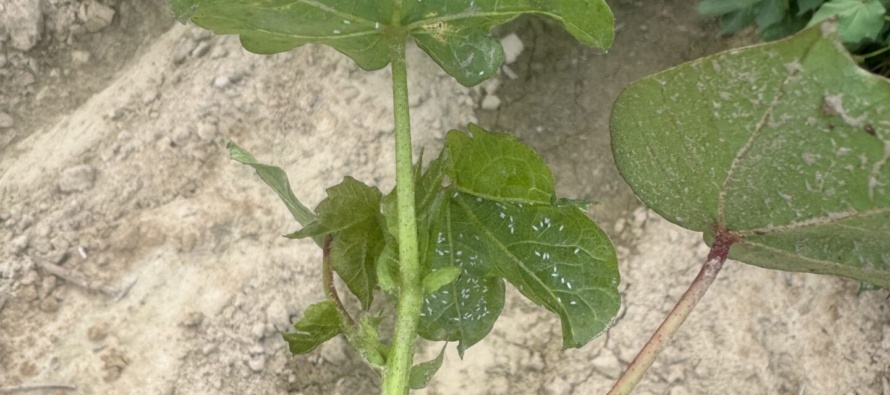
We have been getting questions about larger whitefly populations in cotton than we typically see. From what we have seen, I assume that the majority, if not all of them, are bandedwing whiteflies. Little data have been generated over the last decade on the effects of excessive population levels of bandedwing whiteflies on cotton yield or insecticide efficacy, making informed recommendations difficult. Biology of this pest is important to understand, as immature whiteflies are mobile for the first few days of their lifecycle, before they become immobile until they become adults. This certainly will influence insecticide performance unless a systemic insecticide is used.
The threshold in Mississippi is to apply an insecticide when 50% or more of terminals are infested with adults. While in Georgia, where silverleaf whitefly is common, the threshold is when 50% of leaves on the 5th node from the terminal have multiple immatures present. Given the number of whiteflies we have seen this year, it would not surprise me if that threshold is being exceeded in some areas. However, the cost of managing this pest is likely very high, which throws a kink into making simple management decisions.
In an effort to generate some fresh insecticide data, we deployed a whitefly insecticide foliar trial in Stoneville on July 17th, and rated it 7 days later on July 24th. With limited space for a trial, we prioritized products that provide at least some tarnished plant bug (TPB) activity so that we can try to “piggy-back” the application. We scouted immatures by counting the total number of immature whiteflies in 1 sq. inch of leaf. We also recorded the total number of adult whiteflies by gently flipping a leaf and counting adults. These data sets are shown below:

Fig. 1. Average number of whitefly immatures per square inch of leaf area on the fifth node down from the terminal.
Data collected 7 days after treatment (7DAT) regarding immature whiteflies indicates that none of the insecticides we tested statistically separated from the untreated check. However, some of the products provided numerical reductions in immature numbers, including Transform, Assail, and Sivanto. Imidacloprid and Centric also provided some control. Orthene provided no control of immatures compared to the untreated check. These data indicate the importance of following up with a sequential application targeting whiteflies if populations do need to be reduced.

Fig. 2. Average number of whitefly adults per leaf on the fifth node down from the terminal.
All insecticide treatments significantly reduced adult whitefly densities compared to the untreated control plots except for Centric and Imidacloprid, which were marginal treatments. Sivanto and Assail provided the greatest suppression of adults; however, neither of these is a go-to tarnished plant bug product. I would rather use a good TPB product that is decent on whiteflies than an exceptional whitefly product that provides nothing against TPB.
The interesting portion of this is that a reduction in adults did not always equal a reduction in immatures. This may be related to specific insecticides themselves, or that once immatures enter their immobilized form, it is difficult to know what is dead or alive. This trial will be rated again at 14DAT, and hopefully more information will be gleaned from that.
In short, we had decent luck knocking down adult densities with a few products that we frequently use for plant bug control, which is how I would proceed. There are several other options available, but many come at too high a cost to target whiteflies alone. Just because whiteflies are observed does not mean we need to spend money on them; however, if plant bug applications are necessary, early data indicates that we can reduce whitefly populations in the process. The goal of making whitefly decisions is to maintain healthy plants where necessary. If plants seem healthy and lack symptoms of feeding, continue to monitor those fields, but do not panic into an insecticide application. I will update this post when 14DAT data is available.




Let me tell You a sad story ! There are no comments yet, but You can be first one to comment this article.
Write a comment