
Bollworm Situation in Bt Cotton – August 1, 2026

Related Articles
- Fertilizing Cotton with Poultry Litter 5
- Mississippi Cotton Insect Situation of 2010: A Look Back 3
- Bayer CropScience-O.A. Cleveland Weekly Cotton Commentary 0
Latest Tweets
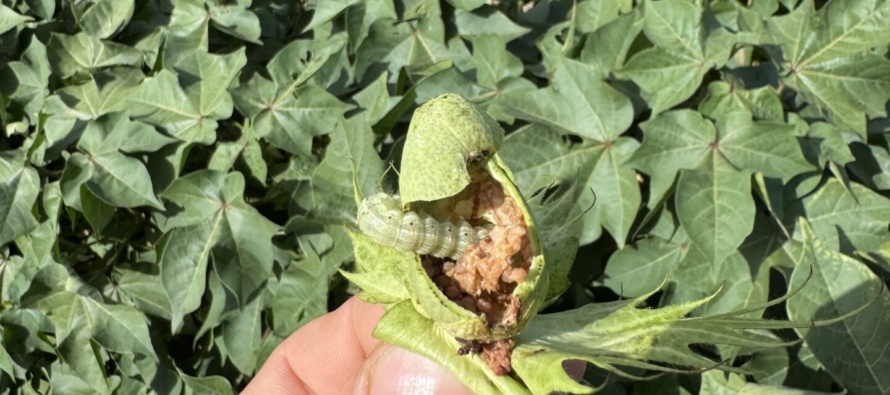
We are aware of heightened levels of bollworms in Bt cotton across the state. There has been an increase in calls regarding bollworms of various sizes surviving on 3-gene cotton. Bollworm larvae are being observed in squares, flowers, and bolls, with larvae ranging in size, but most interestingly, later instars. Finding an occasional small bollworm in Bt cotton is not necessarily unusual, as they need to feed to receive a lethal dosage. However, finding larvae that have survived long enough to reach later instars is more concerning and warrants increased scouting.
At this point, we do not have enough information to call this a widespread Bt failure. We know from resistance monitoring efforts that Vip3A resistance alleles are present in bollworm populations in the environment. Their presence is not evidence that we are experiencing widespread field-level resistance, and based on what we currently know about resistance allele frequencies, we would not necessarily expect “full-blown” failures of Vip3A cotton.
So far, reports appear to be associated primarily with one cotton variety, although we need considerably more information before concluding whether this is truly variety associated. There are several possible explanations for what we are seeing, and resistance is only one of them. We shouldn’t jump to conclusions based on a handful of fields. Additional observations, collections, and testing will be needed to determine exactly what is happening.
Even in light of what is currently occurring, foliar insecticide applications targeting bollworm in three-gene Bt cotton should be based on fruit injury and the presence of live larvae, rather than simply the presence of eggs. If a field reaches the economic threshold, then treat that field. This means that we should be taking structured fruit counts to determine our percentage of damage. Finding a few large larvae feeding on bolls across a large field is not detrimental. However, finding consistent levels of medium to large worms in fruit across the field is much more worrisome.
Remember the threshold: Treat when 1/8″ long or larger larvae exceed 4 larvae per 100 plants or 6 percent damaged fruit of any kind.
We monitor damage by observing 100 fruit, usually 25 squares, 25 blooms, 25 bolls, and 25 terminals. The number of damaged fruit out of these counts gives us our percent damage. In large fields, conduct these counts multiple times across the field to increase confidence in your data.
There is no reason to panic or assume that Vip3A technology is failing across Mississippi. There is also no reason to ignore what we are seeing. The appropriate response is straightforward: increase scouting, document unusual survival, identify the varieties involved, and follow the established damage and larvae thresholds.
If these observations truly are concentrated in a particular variety, we need to determine that quickly. If similar survival begins appearing across multiple varieties and locations, that information becomes even more important.
As always, give us a call if you experience out of the ordinary bollworm activity in your 3-gene cotton fields. (662) 820-4217.




Let me tell You a sad story ! There are no comments yet, but You can be first one to comment this article.
Write a comment