
USDA Revises Crop Acres and Yields in August WASDE

Related Articles
- 2010 Soybean And Corn Variety Trial Data 3
- Rice Variety Trial Results For 2010, Plus Rice Research Report 0
- Fertilizing Cotton with Poultry Litter 5
Latest Tweets
USDA published the latest edition of its World Agricultural Supply and Demand Estimates (WASDE) on August 12, and the report included significant updates to acreage and yield estimates. Before looking at the numbers, it is important to understand why these estimates begin to change more noticeably as the growing season progresses, especially between the July and August reports.
In the July WASDE, planted acreage estimates were based largely on the June 30 Acreage report, which relies heavily on producer survey information collected during the first half of June. Beginning with the August Crop Production report, USDA has substantially more information available to refine those estimates, including updated survey information and acreage data reported by FSA and RMA, along with satellite imagery.
The August report also marks an important change in how yield forecasts are developed. Earlier WASDE projections rely largely on weather-adjusted trend yields. Beginning in August, USDA incorporates survey-based yield expectations and, for major crops such as corn and soybeans, objective field measurements from its Objective Yield Survey. These field observations allow USDA to begin replacing preseason assumptions with information on actual crop conditions and yield potential. More information can be found in the August Crop Production report.
Corn
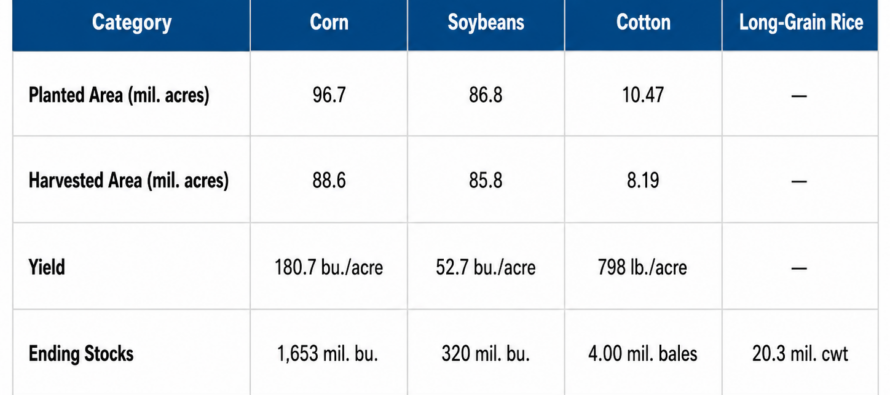
Corn yield was one of the biggest questions heading into the August WASDE. USDA estimated the national yield at 180.7 bushels per acre, down from 183.0 bushels per acre last month. The lower yield was partially offset by an increase in acreage, with planted area rising to 96.7 million acres. USDA also raised its export forecast, but projected ending stocks still declined to about 1.65 billion bushels. That leaves the stocks-to-use ratio near 10%, heading toward a relatively tight scenario and should provide some price support heading into harvest. Reflecting the tighter balance sheet, USDA increased the projected season-average farm price by $0.10 to $4.50 per bushel.
Soybeans
Soybean yield was estimated at 52.7 bushels per acre, down slightly from 53.0 bushels last month. Unlike corn, however, projected ending stocks increased by 10 million bushels to 320 million. The increase in supplies was driven primarily by an additional 1.4 million harvested acres, which more than offset the lower yield estimate. With the larger crop, USDA also increased projected soybean crush by 30 million bushels to 2.78 billion. The season-average farm price was left unchanged at $11.40 per bushel.
Cotton
Cotton yield was reduced to 798 pounds per acre, down from 872 pounds per acre last month. At the same time, planted acreage was increased by 62,000 acres to 10.47 million acres. With exports and domestic use left unchanged, the supply-side revisions resulted in a 100,000-bale reduction in projected ending stocks to 4.0 million bales. USDA also increased the projected national season-average farm price by 2 cents, from 73 cents to 75 cents per pound.
Long-Grain Rice
USDA does not report separate long-grain rice acreage or yield estimates in the August WASDE, but it does provide updated production and demand projections. Long-grain rice ending stocks were increased to 20.3 million hundredweight, up from 17.7 million hundredweight in the July WASDE. The increase was driven by higher production, likely reflecting at least some of the increase in rice acreage. Total U.S. rice planted area was raised by 90,000 acres to 2.11 million acres, with long-grain rice likely accounting for much of that increase. Despite the larger projected supplies, USDA left the long-grain season-average farm price unchanged at $13.50 per hundredweight.
Report Links:
WASDE – wasde0826.pdf
Crop Production – crop0826.pdf





Let me tell You a sad story ! There are no comments yet, but You can be first one to comment this article.
Write a comment