
ARC or PLC for 2026? Prices Point Different Directions by Crop

Related Articles
- Bayer CropScience-O.A. Cleveland Weekly Cotton Commentary 0
- 2010 Row Crop Short Course Video Links 0
- Exemption granted for Corn Seed Bird Repellent 0
Latest Tweets
Producers have until December 11 to choose between Agricultural Risk Coverage (ARC) and Price Loss Coverage (PLC) for 2026. The Farm Service Agency (FSA) opened election and enrollment on September 16. Elections are made crop by crop: each crop’s base acres on a farm can be enrolled in ARC or PLC, but not both. The later deadline gives producers an advantage over past years, when enrollment closed in the spring. With harvest well underway and USDA’s October price projections in hand, producers are making this decision with far more information than usual.
What Prices Are Signaling
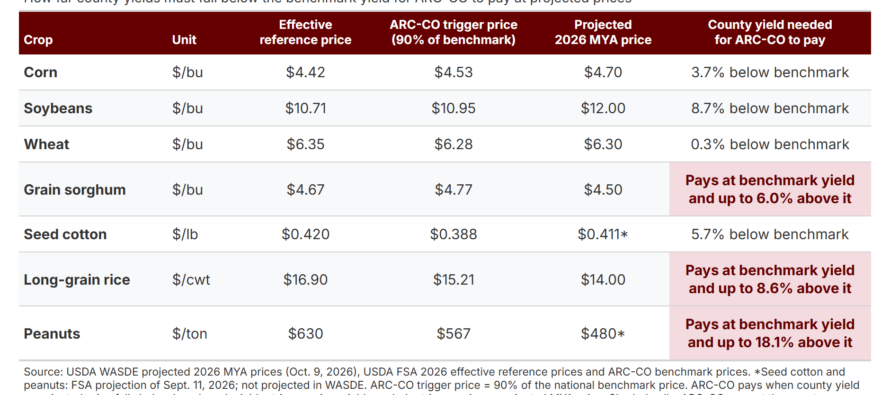
Table 1 compares the two programs’ price triggers for Mississippi’s major crops using USDA’s October projections of the 2026 marketing-year average (MYA) price. PLC pays when the national MYA price falls below the crop’s effective reference price. Corn ($4.70) and soybeans ($12.00) are projected above their reference prices, so no PLC payment is expected. The October report lowered wheat to $6.30, five cents below its $6.35 reference price, which would mean a small PLC payment. Grain sorghum ($4.50 vs. $4.67) and seed cotton are also projected below their reference prices, while long-grain rice ($14.00/cwt vs. $16.90) and peanuts ($480/ton vs. $630) remain well below theirs. The last column shows how far a county’s 2026 yield would need to fall below its benchmark yield for ARC-CO to pay at projected prices. The trigger is a 0.3% shortfall for wheat, 3.7% for corn, 5.7% for seed cotton and 8.7% for soybeans. For grain sorghum, rice and peanuts, prices alone are low enough that ARC-CO pays even if the county yield matches its benchmark. Because the benchmark price is set nationally, these percentages apply to every county’s own benchmark yield. Seed cotton and peanut prices are FSA’s September projections, because WASDE does not project them directly; the October report’s one-cent cut in the upland cotton price will likely lower the seed cotton price slightly when FSA updates its projections.
Because both programs are projected to pay on grain sorghum, long-grain rice and peanuts, producers should compare the actual payments each would make on their farm. PLC payments are based on the farm’s own PLC program yield: the PLC payment rate times the farm’s PLC yield. ARC-CO payments are based on county revenue and are the same per base acre for every farm in the county. A farm with a low PLC yield relative to its county’s ARC-CO benchmark yield may receive more from ARC-CO, even when the PLC payment rate looks larger. At projected prices and with county yields near normal, PLC pays more for rice unless a farm’s PLC yield is roughly 40% of the county benchmark yield or less, and for peanuts unless it is roughly half or less, while ARC-CO pays more for grain sorghum on nearly every farm. Wheat is now a close call: PLC is projected to pay five cents per bushel, and nearly any shortfall in the county yield would trigger ARC-CO.

Comparing Payments on Your Farm
To help producers make that comparison, MSU Extension has developed the 2026 ARC-CO vs. PLC Payment Comparison tool for Mississippi producers. Select your Mississippi county, and the tool estimates 2026 ARC-CO and PLC payments per base acre for each program crop grown there, showing which program pays more. PLC payments start with the county’s average PLC yield. Enter your farm’s own PLC yield from FSA for an estimate specific to your farm. ARC-CO payments start with the county benchmark yield, because the actual 2026 county yield won’t be published until fall 2027. Raise or lower the county yield to see how a short or strong crop would change the ARC-CO payment. Payments update as you type and are shown with the 85% payment-acre factor already applied. Results can be saved to Excel or as an image to share with your FSA office, lender or landlord. Prices in the tool are updated monthly as USDA revises its projections. Development of this tool was supported by the Mississippi Corn Promotion Board.
The tool is an estimate, not a guarantee of payment. Confirm your base acres, PLC yields and election with your local FSA office before the December 11 deadline. For questions about the tool, contact Will Maples at will.maples@msstate.edu or (662) 325-2883.
Decision Tool Link: msstateagecon.shinyapps.io/2026ARCPLCPayments/




Let me tell You a sad story ! There are no comments yet, but You can be first one to comment this article.
Write a comment