
Blank Pods: The Impact of Prolonged Heat on Soybean

Related Articles
- 2010 Soybean And Corn Variety Trial Data 3
- 2010 Row Crop Short Course Video Links 0
- March Ag Supply and Demand Report Recap 0
Latest Tweets
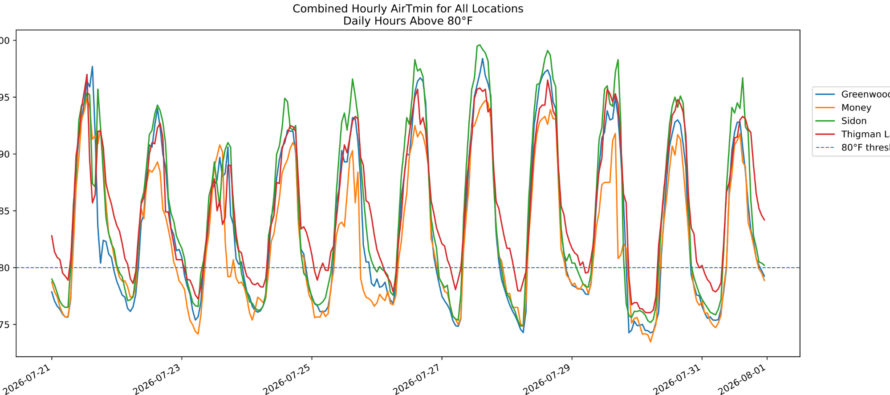
There have been several reports in late-planted soybean, particularly in Leflore and Humphreys counties, of “flat pods” (See picture below). What has happened in these areas is an incidence of seed abortion or arrested development (Wiebold 2012, https://ipm.missouri.edu/cropPest/2012/11/Arrested-Development-in-the-Soybean-Field-Part2/index.cfm). Arrested development can take place at multiple points throughout the reproductive cycle of soybeans. The common denominator for these problematic cases in 2026 has been the region they are located in (main problems being in Humphreys and Leflore counties), their later planting date (May and early-June), and their maturity group ranges. All these details, aligned with seed fill taking place in late-July and August. In this area, there were a couple of extreme heat events that took place. The first was July 21-31 and the second was August 9-20. During these events, temperatures spent much of the time above 80 degrees Fahrenheit. The chart below illustrates hourly air temperatures across four Mississippi Delta weather stations, with a reference line at 80°F to highlight the persistence of elevated temperatures, including overnight. Under prolonged high temperatures, soybean respiration rates increase, consuming carbohydrates that would otherwise be available for growth and seed development. When these conditions persist, increased respiratory demand combined with reduced photosynthetic efficiency can limit the resources available for seed filling, resulting in seed abortion and substantial yield loss. Impacts to yield are most often noted when heat stress occurs at the R5 growth stage (https://soybeanscienceforsuccess.org/2026/09/29/heat-stress-in-soybean/), which is where the late-planted soybean crop in Leflore and Humphreys counties were when these specific events took place. In these cases, yield losses were high (up to complete crop loss in some areas) and the surviving grain was often of poor quality with high damage. Unfortunately, there are few management strategi es that can be altered to avoid these scenarios. Earlier planting can increase the likelihood of avoiding late-season heat events; however, extreme temperatures can also occur in June and July when earlier-planted soybeans are at susceptible reproductive stages. Ultimately, the severity of heat-related yield loss depends heavily on the timing and duration of extreme temperatures relative to crop development.





Let me tell You a sad story ! There are no comments yet, but You can be first one to comment this article.
Write a comment