
Corn Irrigation Strategies for 2026

Related Articles
- 2010 Soybean And Corn Variety Trial Data 3
- Spring Nitrogen Fertility Suggestions for Wheat 0
- 2010 Row Crop Short Course Video Links 0
Latest Tweets
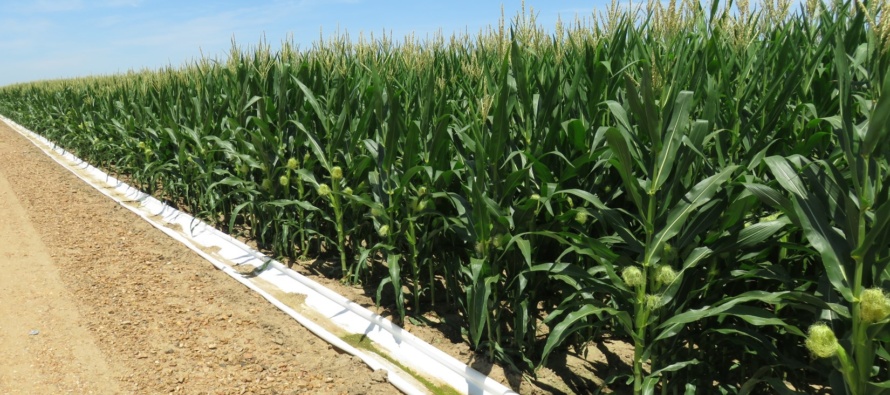
Abundant recent rainfall has suspended irrigation needs relative to normal, considering corn is now tasseling across much of the state. Accordingly, corn water demand will be high when soil moisture dries enough for us to make decisions to commence irrigation. This article will address how various factors affect corn irrigation management.
Since corn’s water demand and sensitivity to stress are highest at tassel and early reproductive stages, we should now implement a liberal irrigation strategy, compared to the more conservative approach we promote during vegetative stages. However, since abundant rainfall has recently blessed us with plentiful soil moisture, these reserves will help alleviate short term needs. However, saturated soils will also impede root growth, so thoroughly checking soil moisture and moderating irrigation intervals remain vital to developing roots, utilizing resources and improving plant health. Consequently, irrigating too early and often can still have negative consequences, including hindering root growth and reducing yield. Historical soil moisture sensor data confirm these findings and show root activity progressing 36-inches deep or more in highly productive Mississippi corn fields. This season’s soil sensor data show corn fields still developing roots and tapping into deeper moisture. In summary, premature or excessive irrigation/rainfall will ultimately limit corn yield, so proceed cautiously.

Corn water use and sensitivity to deficit are highest during early reproductive stages. Accordingly, corn irrigation needs are highest during this time.
The primary factor we should use to trigger corn irrigation is when soil moisture becomes limiting. It is normal to see corn leaves start rolling or wilting the first week or more we go without rain and temperatures climb into the 90’s, despite plentiful moisture in the soil. Thus, leaf wilt is a poor or unreliable indicator of genuine drought stress in our environment. Accordingly, the key factor to determine crop needs is to make a conscientious effort to evaluate soil moisture throughout the root zone. We should evaluate soil moisture availability using simple traditional tools, such as a shovel, probe or auger, or state-of-the-art soil moisture sensors to determine whether the crop needs irrigation and will respond in a manner that will ultimately enhance crop productivity. It is very important to allow plants an opportunity to tap into subsoil moisture and encourage root development which will enhance plant health and productivity.
Keep in mind that the highest irrigated corn yields in the world are traditionally produced in areas with annual rainfall about half or less of our normal. This shows corn is better suited to a lot drier conditions than what we are accustomed to. In fact, a farmer and former world record holder for corn yield stressed his yields would suffer if seasonal rainfall exceeded 30 inches. Accordingly, we should recognize there are negative effects associated with overabundant moisture and manage accordingly. After all, we commonly grow our row crops on raised beds to help relieve issues with overabundant moisture.
As corn approaches the critical tassel and early reproductive stages, irrigation should be scheduled much more generously to fully support increasing crop needs and avoid moisture deficit. A good rule of thumb is corn at V10 growth stage, which is normally 55-60 inches tall, is about two and a half weeks from tassel. Therefore, this transition between irrigation strategies should occur about a week or more after the V10 growth stage. This strategy of using a conservative strategy during vegetative stages, followed by generous irrigation during reproductive stages is supported by long-term corn irrigation studies conducted by Kansas State University and Pioneer Hi-Bred International, Inc.
The key findings of this research include:
- Corn is much more resilient to early-season water deficit than expected.
- Initial irrigation can be safely delayed when soil moisture reserves are ample at planting and deficits are rectified prior to tassel and throughout reproductive development.
- Soil moisture in the profile is the best indicator for initiating and scheduling irrigation.




Let me tell You a sad story ! There are no comments yet, but You can be first one to comment this article.
Write a comment