
Horseweed Identification Guide

Related Articles
Latest Tweets
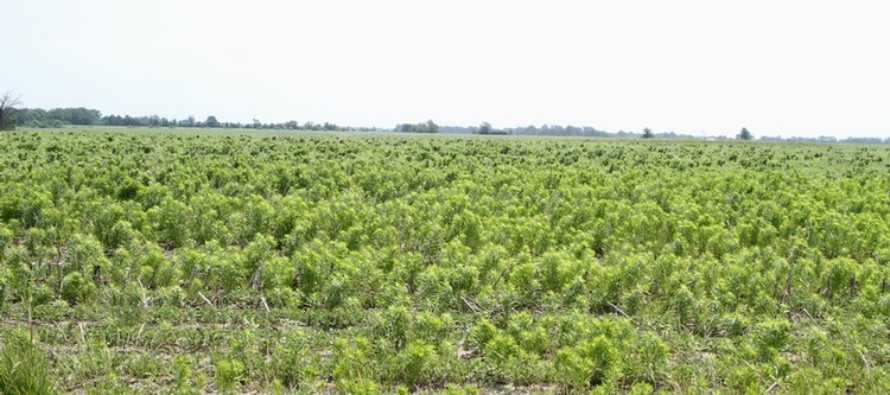
Horseweed is an erect winter annual weed that is problematic in most Mississippi row crops. This species emerges in early fall and forms a rosette throughout the winter. In spring, horseweed begins to elongate upward and may persist through early summer. Like many other winter annual weed species, fall-applied residual herbicides are effective in preventing emergence of horseweed. Emerged horseweed in fall and early-spring is best controlled with 2,4-D or dicamba. Many populations across Mississippi are resistant to glyphosate and paraquat. Recognizing this weed at early developmental stages allows for prompt herbicide applications and improved control.
- Latin name: Conyza (sometimes Erigeron) canadensis (L.) Cronq.
- Family: Asteraceae (Sunflower)
- Life cycle: Winter annual
- Synonyms: Marestail or mare’s tail, Canadian fleabane, hogweed
Identifying Characteristics
- Cotyledons have smooth margins and appear to lack veins.
- Leaves on older plants are linear, alternate, exhibit toothed margins, and are attached directly to the stem.
- Stems can reach up to 6.5 ft and are covered in bristly hair.
- Inflorescences (flowers) are numerous and are arranged along an elongated panicle. These florets are often white to lavender in color and even yellow in some instances.

Seedling horseweed. Credit: Univ. of Missouri Div. of Plant Sciences.


Horseweed in basal rosette stage. Credit: Univ. of Missouri Div. of Plant Sciences.

Credit: Dr. Jason Bond

Seedling horseweed. Credit: Univ. of Missouri Div. of Plant Sciences.




Let me tell You a sad story ! There are no comments yet, but You can be first one to comment this article.
Write a comment