
Henbit Identification Guide

Related Articles
Latest Tweets
Henbit is an erect or spreading winter annual weed that is commonly found in crop fields, roadsides, pastures, and lawns throughout Mississippi. Henbit is problematic in most spring-seeded crops such as corn, rice, and soybean. Like many other winter annual weed species, fall-applied residual herbicides are effective in preventing emergence of henbit. Emerged henbit can be relatively difficult to control, depending on herbicide selection and growth stage of the weed. Common spring burndown herbicides such as glyphosate and paraquat are not as effective on mature henbit. In these situations, a phenoxy herbicide such as 2, 4-D or dicamba, depending on the crop to be planted, should be added. Successful identification of the weed at early growth stages will allow for more timely and successful herbicide treatments.
- Latin name: Lamium amplexicaule
- Family: Lamiaceae (Mint)
- Life cycle: Winter annual
- Synonyms: Dead-nettle, henbit dead-nettle
Identifying Characteristics
- Cotyledons are oval and hairless.
- Stems have numerous ascending branches, are nearly square, and root at lower nodes.
- Flowers are reddish-purple in color.
Distinguishing between henbit and purple deadnettle (Lamium purpureum)
Henbit is often confused with purple deadnettle. Both species have square stems and share the same reddish-purple flowers. However, the leaves of purple deadnettle are more deeply serrated and pointed as opposed to the lobed shape of henbit. Mature leaves in the upper canopy of purple deadnettle plants may also have the same reddish-purple color found on the flowers.

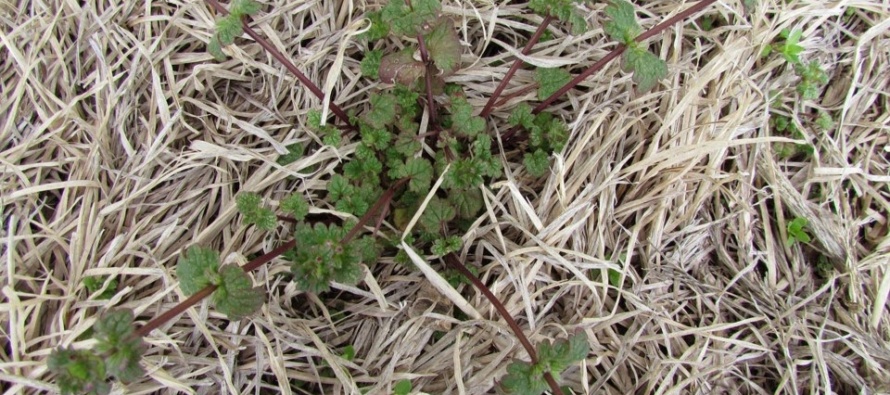
Henbit during early growth stage. Credit: Purdue University Turfgrass Science.

Mature henbit plant with flowers. Credit: Purdue University Turfgrass Science.

Henbit compared to purple deadnettle. Credit: NC State University.

Mature purple deadnettle. Credit: Cornell University CALS.

Purple deadnettle in early growth stage. Credit: Purdue University Turfgrass Science.

Square stem found on both henbit and purple deadnettle. Credit: Purdue University Turfgrass Science.




Let me tell You a sad story ! There are no comments yet, but You can be first one to comment this article.
Write a comment