
Cutleaf Evening-Primrose Identification Guide

Related Articles
Latest Tweets
Cutleaf evening-primrose is a herbaceous winter annual or biennial weed with extremely wide variation in growth habits and leaf shapes. The species is common in agronomic fields, pastures, roadsides, gardens, and waste sites in Mississippi. Cutleaf evening-primrose can be a severe problem for spring burndown, especially in fields where all tillage is completed in the fall. Glyphosate or paraquat are generally ineffective when applied alone. Tank mixtures of 2,4-D or dicamba with glyphosate applied in early-spring should adequately control cutleaf evening-primrose prior to planting. Although it is not toxic, this weed is most problematic in pastures because its texture makes it unsuitable for forage and it also lowers hay quality.
- Latin name: Oenothera laciniata Hill
- Family: Onagraceae (Evening Primrose)
- Life cycle: Winter annual or biennial
Identifying Characteristics
- Cotyledons are kidney-shaped and have petioles.
- Most leaves have a distinctive white midvein.
- Leaves initially develop as a basal rosette and can be irregularly lobed along the margin.
- Hairs are present on the tops of leaf blades but not underneath
- Stems are often hairy and usually red in color. Stems may be simple to highly branched.
- Flowers are yellow or red.

Cutleaf evening-primrose shown in the basal rosette growth stage. Credit: Oklahoma State University.

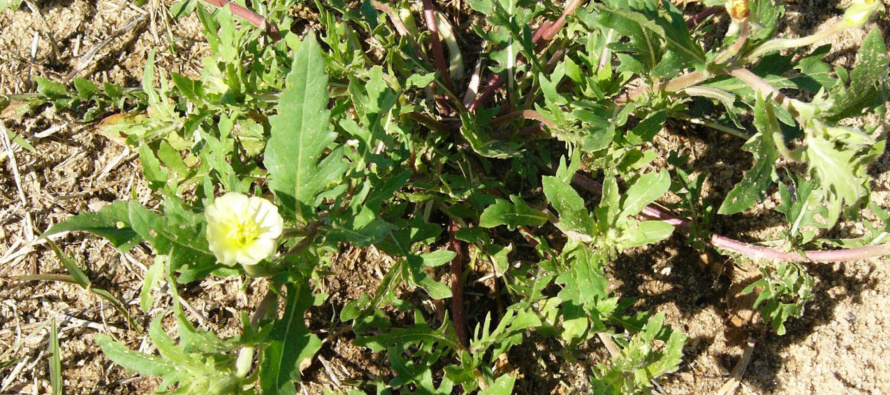
Cutleaf evening-primrose growth habit. Credit: North Carolina State University Extension.

Flowering cutleaf evening-primrose. Credit: North Carolina State University Extension.





Let me tell You a sad story ! There are no comments yet, but You can be first one to comment this article.
Write a comment