Redbanded Stink Bug Update 7/15/2017
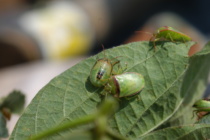
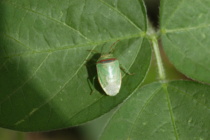
We have sprayed several fields in the last 2 weeks for RBSB’s. To date, most fields have been late March planted beans that are R5.5-R6 growth stage. Most of the fields so far have been south of Hwy 82, but
The soybean disease situation continues to change throughout MS depending on growth stage situations in each field. Over the past week root diseases have been commonly observed. The first soybean rust of the season was observed in southwestern MS on kudzu.
Over the past several years, fungicide pre-mix products have dominated the marketplace. Keeping up with the specific chemical classes within each product can present a challenge. Included in this blog post are some information to aid in making fungicide decisions.
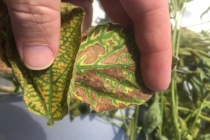
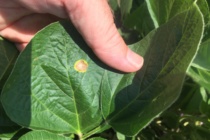
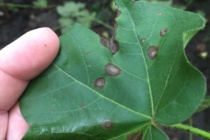
Limited soybean diseases have occurred throughout the MS soybean production system. Observations of Septoria brown spot and taproot decline have been quite common this season. Lesions that result from herbicide injury have also been commonly observed, but should not be cause for concern.
Getting more calls everyday about low numbers of Redbanded Stink Bugs (RBSB) in R2/R3 soybeans. Many are asking about what to mix with a fungicide to take them out. Before jumping out too quickly, consider this, I would suspect very little
Over the past week calls have started to be received regarding the automatic fungicide application in soybean. On-farm, large plot trials were conducted during 2015 and 2016 to assess the benefit of several different fungicide products and to reevaluate the automatic application timing. At present, we believe that a mixed mode of action fungicide, or one that provides more than one mode of action would be more beneficial than the stand-alone strobilurin (QoI) fungicide application that has become popular over the past decade.
In 2009 Redbanded stink bugs (RBSB) were treated in numerous areas of the state but numbers crashed in 2010. In 2013 there were a few fields treated and then they essentially were a non-issue until 2016. We have been hearing
Mississippi State University will be hosting 4 scout schools this year. We have transitioned over the years to make these trainings much more diverse than insect pest alone. This year we will be including insects, disease, fertility, and herbicide symptomology. There
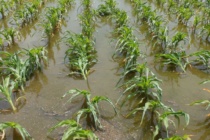
By now I am sure everyone has seen the pictures of the flooding occurring from recent rains in across the river in Arkansas and Missouri. Compared to those states, Mississippi has fared pretty well in regards to flooding of young
Target spot management in soybean production systems remains a hot topic going into the 2017 season. The environment that occurred during late July and early August 2016 made us respect a disease that is often “out of sight and out of mind”. Fungicide data from two efficacy trials conducted during 2016 are included in this blog post.
Labeling for new auxin herbicide products detail requirements that either restrict application or require buffers between the treated field and sensitive areas or susceptible crops.
Mississippi State University will be hosting 4 scout schools this year. We have transitioned over the years to make these trainings much more diverse than insect pest alone. This year we will be including insects, disease, fertility, and herbicide symptomology. There
New auxin herbicide products have associated websites, which are considered extensions of the federal labels, that list additives and herbicides approved for mixture.
Target spot was one of the main diseases that occurred during 2016. Normally a disease of little consequence in soybean as well as cotton, severe target spot outbreaks were observed in both crops. Making decisions regarding the occurrence of target spot during 2016 are difficult since the environment during key plant growth stages was the most important ingredient for the occurrence of target spot last season.
Observing the preplant intervals for 2,4-D and dicamba prior to planting is important.
New labels for herbicide products to be used in Enlist and Xtend crops have unique application specifications.
New auxin herbicide-resistant crop technologies are not a return to the days when Palmer amaranth of any size could be completely controlled with a single herbicide application
New herbicide-resistant technologies offer the option to use herbicides previously not labeled for in-season application in cotton and soybean
New herbicide-resistant crop options are available for 2017 in the form of the Enlist Weed Control System from Dow Agrosciences and the Roundup Ready Xtend Crop System from Monsanto.
Spring tillage with the intent of controlling GR Italian ryegrass is nearly futile.
MSU Extension is hosting a series of meetings to be held throughout the state to prepare growers for the upcoming season. These meetings will focus on market outlooks, variety selection, weed management, insect and plant disease management, and other current crop production
Mississippi producers interested in purchasing auxin-containing herbicides intended for in-crop use on 2,4-D- or dicamba-tolerant crops must first complete mandatory online training.