|
|
By Angus Catchot, Extension Entomologist, Don Cook, Research Entomologist and Jeff Gore, Research Entomologist, on May 17th, 2013%
Due to the rain and cold weather this spring a much larger percent of the soybean crop will be planted later than normal. There have been several questions lately about whether or not we should still include an insecticide seed treatment on late planted soybeans. I dug through all my old data trying to separate out . . . → Read More: Do Insecticide Seed Treatments Provide any Value on Late Planted Soybeans?
By Jeff Gore, Research Entomologist, Angus Catchot, Extension Entomologist and Don Cook, Research Entomologist, on May 17th, 2013%
I have been asked several times over the last week about the need for thrips control now that we have more optimal planting conditions. This is a good question and I will attempt to provide some valuable insight about thrips control in both cotton and peanuts. . . . → Read More: Thrips in Cotton and Peanuts
By Erick Larson, State Extension Specialist - Grain Crops, on May 16th, 2013%
 The relentless rainfall that hindered corn planting this spring has increased acreage intentions for grain sorghum. This article outlines some key planting tips for successful sorghum production. . . . → Read More: Seeding Rates and other Grain Sorghum Planting Tips
By Tom Allen, Extension Plant Pathologist, Jason Bond, Research/Extension Weed Scientist, Tom Eubank, Research/Extension Weed Scientist and Trent Irby, Extension Soybean Specialist, on May 14th, 2013%
Within the past week to 10 days, numerous fields have been diagnosed as having “Pythium seedling disease”. In most cases, herbicide injury has resulted in fields appearing to have an uneven stand as a result of seedling disease. Rarely would a seedling disease be responsible for large acreages of dead seedlings. More than likely, a combination of events have occurred to cause the appearance of seedling disease. Preemergence herbicides, cool temperatures, excessive rainfall following planting immediately prior to emergence, light soil texture, and herbicide injury on stressed soybean seedlings have all compounded the stressful situation. . . . → Read More: Soybean Seedling Issues: Seedling Disease Versus Herbicide Injury
By Larry Oldham, Extension Soils Specialist and Erick Larson, State Extension Specialist - Grain Crops, on May 14th, 2013%
 Persistent rainfall has periodically saturated corn fields for several weeks this spring, prompting questions regarding potential nitrogen fertilizer loss. This article gives guidelines for estimating potential N loss. . . . → Read More: How to Estimate Nitrogen Loss resulting from Saturated Soils
By Tom Allen, Extension Plant Pathologist, on May 11th, 2013%
Oftentimes dealing with foliar wheat diseases can be a confusing topic. More often than not, physiological leaf spotting, or genetic leaf spot, can be observed in most wheat fields after flowering stages. However, the leaf spot symptoms are occasionally misdiagnosed as early leaf rust symptoms. But, rarely have I observed a disease epidemic in a situation where the specific “flecking” symptoms are regularly observed. . . . → Read More: Wheat Leaf Topics and Physiological Leaf Spotting
By Darrin Dodds, Extension Cotton Specialist, on May 11th, 2013%
Very little cotton has been planted so far this year given the seemingly weekly rainfall. What little cotton has been planted has struggled due to cool temperatures, water saturation, etc. In some cases, fields are not going to emerge to an adequate stand and re-planting will be necessary. Changes have been enacted with respect to re-plant . . . → Read More: Cotton Replant Costs
By Angus Catchot, Extension Entomologist, Jeff Gore, Research Entomologist and Don Cook, Research Entomologist, on May 10th, 2013%
Earlier this week Transform WG insecticide from Dow received a full Section 3 label for use in cotton. . . . → Read More: Transform WG Insecticide from Dow Recieves Label for Cotton
By Erick Larson, State Extension Specialist - Grain Crops, on May 7th, 2013%
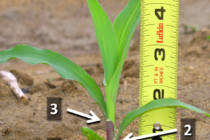
 Vegetative growth stages of corn or sorghum are determined by counting the number of fully emerged leaves with leaf collars present. This can be used to anticipate growth and determine appropriate timing of many management decisions, including herbicide application, sidedress fertilizer, etc…. . . . → Read More: How to Determine Growth Stages of Young Corn or Sorghum
By Tom Allen, Extension Plant Pathologist, on May 4th, 2013%
Scattered reports of wheat diseases have been made over the past two weeks. Limited leaf rust, stripe rust, and Septoria leaf blotch can be observed in some wheat fields. In addition, in some situations bacterial leaf streak can be readily observed on flag leaves in some limited situations. In some cases, bacterial leaf streak and Septoria leaf blotch can appear similar to one another. In most cases, Septoria leaf blotch can be observed in the lower canopy and likely will not move up the plant to the flag leaf. However, bacterial leaf streak can be more readily observed on flag leaves in some fields. . . . → Read More: Wheat Disease Update: May 4, 2013
|
Subscribe to receive updates
From Our ReadersThis is content created by our users. If you want to add something, click the "Contribute" button below. Unexpected error, got no error message.
|
Follow Us: