Fungicides Labeled for Use On Peanuts in Mississippi, 2014
This post links to lists of fungicides labeled for use on Mississippi grown peanuts as of February, 2014. Each document sorts the same information different ways.

This post links to lists of fungicides labeled for use on Mississippi grown peanuts as of February, 2014. Each document sorts the same information different ways.
A substantial number of soybean acres have been reported to be affected by seedling disease. However, the majority of the field seedling issues can be blamed on poor environmental conditions following the planting that occurred around Easter (between April 14 and 19) and some of the residual herbicide products applied.
Even though additional foliar wheat diseases have been observed throughout MS, I still consider this to be one of the cleanest wheat crops I have seen. At present, extremely low levels of leaf rust have been observed in two locations, stripe rust on a few protected plants in Stoneville, Septoria leaf blotch, glume blotch, and tan spot have all been reported in the MS wheat crop.
Before the rice season gets into the full swing, consider several important fungicide application strategies before the mid-season fungicide application. Preventing fungicide-resistance from developing is the first step in managing the issue.
We have had several calls in recent days as news gets out about the EPA’s recent label changes for neonicotinoid insecticides. The intent is to offer greater protection for pollinators in and around crops where this class of insecticides may be applied. Basically, the new language forbids the use of these products while bees are foraging and until flowering is complete and all petals have fallen off the plants. There are a few exceptions if certain criteria are met.
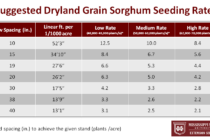
Mississippi growers will likely plant far more acres to grain sorghum than previous years. This article outlines suggested seeding rates and other key planting tips for successful sorghum production.
Although very little, if any, cotton has been planted in the Delta, it is not too early to start thinking about managing tarnished plant bugs.
Decisions to apply a fungicide to wheat should be based on the specific variety planted, response of the particular variety to foliar diseases that could impact yield, growth stage at time of decision, and whether or not the environment has been conducive for disease development. At present, foliar disease that could reduce yield have not been observed in commercial wheat fields.
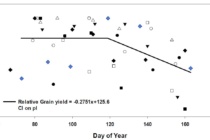
Many people ask why continue mundane planting date research don’t we have enough. Truth is, when talking about items such as planting date, and soil testing data that will be modeled, there is never enough data. The more data you
I don’t have to tell any of you the amount of rainfall we have had over the last several weeks. Most of the rainfall we have receiving has been high intensity rainfall (i.e. all coming down at once). High intensity
Dr. Jeff Johnson, Head of the Delta Research and Extension Center, has assigned responsibility for Extension in rice to Dr. Bobby Golden. Dr. Golden will serve in this capacity until a suitable candidate is identified for the Rice Agronomist/Extension Specialist
Wheat diseases remain extremely scarce throughout the MS wheat production system to date. No leaf rust, stripe rust, or Septoria have been observed to my knowledge. However, bacterial leaf streak has become a regular observation in most wheat fields.
Much like last year, as rains delay corn planting progress, more concerns arise regarding the appropriate “cut-off” date for planting corn. This article states new guidelines for late corn plantings based upon recent MSU research.
Wheat diseases have been essentially non-existent this winter. No rust to report and very little of much any other foliar diseases is great news for our wheat farmers.
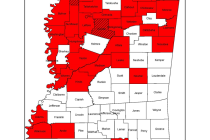
Strobilurin-resistant frogeye leaf spot continues to be a topic of conversation. During 2012 two MS counties were confirmed to have strobilurin resistant frogeye leaf spot. Since that time a large survey has been conducted in MS to determine how widespread the resistance is within the fungal population in MS.
Supplemental labeling will allow in-season applications of Sharpen to rice in 2014.
Fungicides have become an important management alternative for diseases such as frogeye leaf spot. However, with the addition of the strobilurin-resistant fungus responsible for frogeye leaf spot, caution must be taken when applying fungicides to not increase the likelihood of fungicide resistance from developing. The specific characteristics of the main fungicide classes labeled for application in soybean systems are outlined. In addition, a table that includes the specific components of the pre-mix products when the labeled rates are applied is included.
Fungicide resistance has continued to be a hot topic during the off-season. Since 2010, fungicide resistance within the frogeye leaf spot fungal population has been documented in several states including Mississippi. To prevent the development of fungicide resistance from increasing several important steps can be followed. Several of these specific topics will be outlined in this three part series regarding fungicide resistance.
Recently several groups in Mississippi came together and developed then adopted a set of Cooperative Standards for row crop farmers and beekeepers in an effort to increase awareness of pollinator’s and create an environment where each could coexist while minimizing any
Just to prove that 2,4-D labels can be confusing, plantback restrictions were listed correctly in the previous post, but formulations were not specified.
With the cold, wet weather, many burndown herbicide applications were delayed. This has led to a multitude of questions on plantback restrictions for 2,4-D and dicamba prior to planting corn and soybeans.
I have gotten numerous question about calibration of in-furrow rigs this year, so I am republishing an article I put up in the past that breaks calibrating pesticides down to a very easy understandable level. Proper calibration can mean the difference in control or failure of a product against the targeted pests and potentially thousands of dollars of savings to the grower.
The annual cotton maturity guide has been updated for 2014. Cotton is unique with respect to maturity indices, especially compared to commonly grown grain crops. Generally speaking, the earliest maturing cotton varieties differ from the latest maturing cotton varieties by
During 2013, several fungicide trials were conducted to determine the benefit of vegetative growth stage timings in corn. Two large plot trials were conducted in east MS with the help of Dr. Dennis Reginelli. In this blog post, the results of two large plot trials were presented from one nonirrigated and one irrigated field setting. Small plot trial data will be reported at a different date.
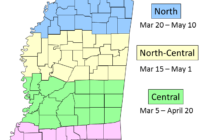
March is here, anticipation is building and our fields may dry out soon, if rain holds off. So when should we start planting corn? This article gives tangible recommendations for determining suitable planting time when nature throws us curveballs.

© 2023 Copyright Mississippi Crops. All Rights reserved.
