Back to homepage

3. By Editor

Soybean Loopers Showing up in Late Soybeans: Updated

🕔14:34, 5.Sep 2014

Soybean loopers are starting to show up in high numbers in many areas of the state. In many cases, soybeans are past the point where yield loss can occur, but there are many later planted soybeans that need to be protected for a while longer. Below are a few tips on when to treat and what to treat with.
Read Full Article▸

Identifying Soils that “Seal” and Improving Irrigation Application Efficiency in “Sealing” Soils Updated

🕔09:44, 4.Sep 2014

  This summer we had multiple conversations with producers that either irrigated or had significant rainfall events on their field, but the soil moisture sensors below the 6 inch depth never “detected” the irrigation or rainfall event (see https://www.mississippi-crops.com/2014/06/26/is-my-soil-moisture-sensor-broke/ ).

Read Full Article▸

Foliar Soybean Disease Update: September 3, 2014 Updated

🕔22:04, 3.Sep 2014

Foliar diseases of soybean continue to be observed throughout the MS soybean production area. At present, no soybean rust has been detected in MS; however, Cercospora blight and frogeye leaf spot as well as several pod diseases (topic of the next blog post) are being observed in numerous soybean fields.

Read Full Article▸

Lime Need and Value Updated

🕔13:45, 3.Sep 2014

Acid soils often need liming to aid crop growth and development. Fall applications provide more time for the lime to react with the soil, less stress on the human component, and better field conditions  for equipment operation. Soil acidity problems

Read Full Article▸
Fungicide Phytotoxicity: Check the Fungicide Applied Prior to Blaming SDS

Fungicide Phytotoxicity: Check the Fungicide Applied Prior to Blaming SDS Updated

🕔18:28, 31.Aug 2014

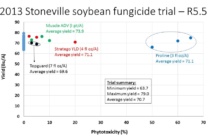
Phytotoxicity, associated with the application of some specific foliar fungicide products, has been observed in numerous commercial soybean fields again this season. Keep in mind that the symptoms associated with fungicide phytotoxicity will appear quite similar to sudden death syndrome (SDS). However, SDS only occurs in light soil classes. When scouting fields, keep in mind that an entire field with SDS-like symptoms might be the result of fungicide phytotoxicity, thus not a disease after all.

Read Full Article▸
When to Terminate Bollworm Sprays in Late Season Bt Cotton

When to Terminate Bollworm Sprays in Late Season Bt Cotton Updated

🕔16:00, 29.Aug 2014

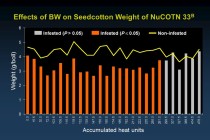
We have had numerous calls over the last couple weeks about small, 2-5 day old larvae, under bloom tags in Bt cotton that is near, at, or beyond cutout. All of the research done to this point suggests that cotton is safe from bollworm damage when it reaches node above white flower 5 plus 300 heat units.

Read Full Article▸
Insect Trap Counts, August 29, 2014

Insect Trap Counts, August 29, 2014 Updated

🕔11:09, 29.Aug 2014

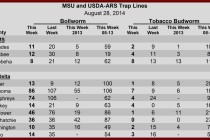
Bollworm pheromone catches were lower again for the second consecutive week, suggesting that once control is achieved for current larval populations, a major reinfestation is unlikely. Tobacco budworm catches were also lower this week.

Read Full Article▸

Fall 2014 Lime Programs Updated

🕔14:19, 28.Aug 2014

With harvest beginning, it is time to think about the next crop. Fall liming allows time for the soil to react before the next summer crop is planted, and takes advantage of the (usually) drier conditions for field operations. Soil

Read Full Article▸

Reminder: Soybean Irrigation Termination Turnrow Talks – August 26, 2014 Updated

🕔13:23, 25.Aug 2014

Plan to attend an upcoming Irrigation Termination Turnrow Talk on August 26, 2014 sponsored by the Mississippi Soybean Promotion Board, Mississippi State University Extension Service, and stakeholder organizations of the Delta Sustainable Water Resources Task Force. Soybean producers will have

Read Full Article▸
Soybean Irrigation Termination

Soybean Irrigation Termination Updated

🕔13:05, 25.Aug 2014

We have reached the point of the growing season where we have begun to terminate irrigation in soybean. When making this decision, the goal is to make sure that adequate soil moisture is available to ensure that the soybean seeds

Read Full Article▸

Cotton Irrigation Termination Updated

🕔11:39, 22.Aug 2014

As we approach the end of August, terminating cotton irrigation is on the mind of many folks.  In cotton, we recommend terminating furrow irrigation at first cracked boll.  If you anticipate bolls opening in the immediate future and have been

Read Full Article▸
Insect Trap Counts, August 22, 2014

Insect Trap Counts, August 22, 2014 Updated

🕔10:57, 22.Aug 2014

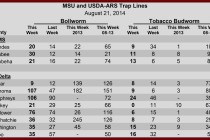
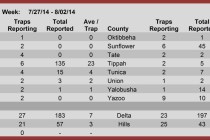
This week’s bollworm trap catches were similar to slightly higher than last week, while tobacco budworm trap catches fell slightly for the week. The trap catches are typical for this time of year, so expect moderate worm pressure in all sensitive crops.

Read Full Article▸

Bean Leaf Beetle Numbers Picking Up in Mississippi Soybeans Updated

🕔07:55, 22.Aug 2014

Bean leaf beetle numbers have been increasing steadily over the last couple weeks. We have actually made bean leaf beetle targeted sprays on a number of acres in recent days. Yield loss is caused by defoliation and less frequently by

Read Full Article▸

Soybean Disease Update: August 16, 2014 (UPDATED) Updated

🕔15:22, 16.Aug 2014

Diseases of soybean continue to be observed throughout the MS production system. At present, soybean rust has not been detected within MS; however, we continue to scout for the presence of rust, as well as additional diseases of economic importance throughout sentinel plots as well as commercial soybean fields. Frogeye leaf spot, sudden death syndrome, stem canker, and aerial blight continue to be hot topics for most soybean farmers.

Read Full Article▸

Terminating Insect Sprays in Mississippi Soybeans Updated

🕔11:56, 15.Aug 2014

We are quickly approaching that time of year where some of the earlier planted fields are turning color and others are approaching R6 vey quickly. Often times many of the insect pest we deal with “pile in” about this time and growers face the tough decision to treat when it may not pay back or try and race them to the end. We have devoted a lot of time and effort in recent years to evaluate and validate thresholds in soybeans under the current growing practices in Mississippi. Through these research efforts we have made several changes to insect thresholds and termination points for insect pest of soybeans in MS.

Read Full Article▸
Bollworms in Dual Gene Bt Cotton: Control and Expectations

Bollworms in Dual Gene Bt Cotton: Control and Expectations Updated

🕔07:29, 15.Aug 2014

Over the last 7 days we have had numerous reports of high bollworm numbers in some BollGard II, TwinLink, and WideStrike fields in the Mississippi Delta. We have seen fields in the past that reach treatable levels but some reports are much higher than we have seen in recent years. At this time there does not appear to be any specific varieties that are adversely affected more than others. It appears to be a function of high pressure in isolated areas at this time.

Read Full Article▸

Transform Section 18 Amendment Allows 3rd Application to Sorghum Updated

🕔16:05, 14.Aug 2014

White sugarcane aphid continues to be a serious problem in grain sorghum fields across Mississippi and the Mid-South. Because this is a brand new pest, there are many questions still unanswered. The Mid-South Entomology Working Group is frantically working on

Read Full Article▸
Insect Trap Counts, August 14, 2014

Insect Trap Counts, August 14, 2014 Updated

🕔10:33, 14.Aug 2014

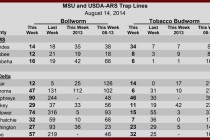
After 4 weeks of high bollworm moth catches averaging more than 75 moths/trap/week, this week has dropped down to an average catch of 35 moths/trap. This should mean that once current worm populations are controlled, a substantial reinfestation is not likely. However, tobacco

Read Full Article▸

When is it safe to Apply a Grain Sorghum Harvest Aid and what to Expect? Updated

🕔08:45, 14.Aug 2014

Many growers in the Mid-South apply a herbicide shortly prior to sorghum harvest to facilitate combine efficiency and suitable grain moisture. This season, this issue is even more critically important because of severe harvest problems potentially created by White Sugarcane aphid infestation. This article will discuss appropriate timing and potential outcome of such harvest aid applications.

Read Full Article▸

Last Effective Bloom Date in Cotton Updated

🕔13:00, 8.Aug 2014

The last effective bloom date is the last date that a white flower will accumulate enough heat units to mature into a harvestable boll.  Generally speaking it takes 850 heat units for a white flower to mature into a harvestable

Read Full Article▸

Soybean Disease Update: August 1, 2014 Updated

🕔11:10, 1.Aug 2014

Soybean diseases continue to be observed throughout MS. Brown spot, aerial web blight, frogeye leaf spot, Cercospora blight are the predominant foliar diseases observed at present. In addition, several root diseases are becoming apparent from fields across the state.

Read Full Article▸
Insect Trap Counts, Aug. 1, 2014

Insect Trap Counts, Aug. 1, 2014 Updated

🕔10:58, 1.Aug 2014

Bollworm moth catches continued to be high across the state for the 3rd week in a row as the larvae that developed in corn continue to emerge. Expect significant bollworm larval pressure in vulnerable crops. Tobacco budworm moth catches rose

Read Full Article▸

Another Surge Valve Experience! Updated

🕔10:47, 1.Aug 2014

This week we encountered another issue with a surge valve. After irrigating with a surge valve the producer noted that neither the 6” nor 12” sensors responded to the irrigation. When investigating the problem it appeared that the grower had

Read Full Article▸

What Should You do about Late Southern Corn Rust? Updated

🕔09:54, 1.Aug 2014

Southern corn rust continues to be observed throughout MS. We continue to receive calls regarding late fungicide applications (> R4/R5) to reduce yield losses attributed to southern rust. Numerous myths regarding the disease have been widely spread throughout the MS corn production area including death of a corn plant in as fast as 7 days following southern rust infection and lodging as a result of heavy southern rust infection.

Read Full Article▸

White Sugarcane Aphid Update – 8/1/2014 Updated

🕔09:48, 1.Aug 2014

White sugarcane aphid infestations are increasing across the state and more applications are going out to manage this pest. Over the last week to 10 days we have heard about numerous fields that have received a second application. Remember, that the Section 18 label for Transform states that no more than 2 applications can be made in a field.

Read Full Article▸