Weed of the Week: Browntop Millet
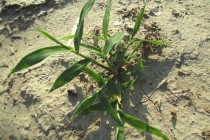
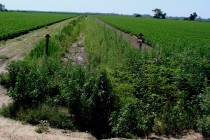
In Mississippi, browntop millet is found in cultivated areas, lawns, pastures, and along roadsides.
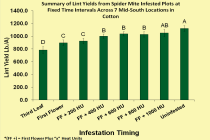
When to terminate spider mite treatments can be a very difficult decision this time of year. Spider mites can cause yield loss directly by feeding on small squares and bolls causing them to abort, or indirectly by feeding on leaves which reduces photosynthesis not allowing bolls to fill out correctly. In many ways this indirect damage would be very similar to defoliation.
Foliar leaf spot diseases continue to be observed throughout the MS cotton production area. Determing the particular leaf spot at the field level can be quite difficult especially if the leaf spots are a result of a foliar potassium deficiency. Bacterial blight, Corynespora leaf spot, and various other fungal diseases are being observed at present within our production system.
As a Plant Pathologist, I tend to divide the peanut crop in Mississippi into growing areas based on the “climate†and soils. Both influence the type and amount of disease pressure experienced in that growing area and, incidentally, quality and
Open bolls are beginning to appear in several areas of the state which is signaling that we are headed toward the finish line with this crop. However, several calls have come in this week regarding fruiting gaps present in a
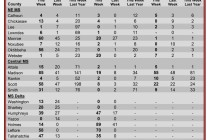
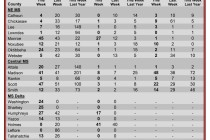
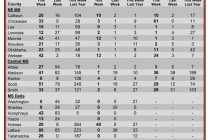
Bollworm pheromone trap counts were lower in all regions of MS this week and they weren’t very high before. Tobacco budworm and beet armyworm catches also remain at low levels. Unless something dramatic happens in the next few weeks, it looks like
Tillage (disking, chisel plowing, etc.) is a common means of post-harvest weed control and a way to encourage rapid degradation of crop residues. However, this process can also bring new weed seeds to the surface, allowing them to germinate.
Sicklepod is competitive with row crops during their seedling stages, so the first few weeks after planting are critical for control.
Six locations of the MS wheat variety trial plots were rated for the presence of leaf and stripe rust. Included is information regarding the reaction of each of the varieties contained to aid in determing the best wheat varieties with rust tolerance to plant for the 2012/2013 season.
Current update Last of July/First of August and Tropical Storm Ernesto Advisory White mold White mold began germinating and growing on dead organic matter in the south about 18 days ago in south central Mississippi, but really started to kill
Fall armyworm can be a challenging pest to find and an even more challenging pest to manage in some crops. The damage that they cause and their management varies greatly from crop to crop. The reason for this is due to their preferred feeding sites on different crops and the presence of host strains.
To date, the majority of Mississippi’s soybean crop is either blooming, setting pods, or turning color in places. Some isolated fields in parts of Bolivar, Issaquena, and Washington counties have been harvested over the past 10 days. Since July 4,
Please click the link below to hear the latest podcast on terminating insecticide sprays for defoliators in soybean.. Terminating Defoliator Sprays in Soybean
Bollworm pheromone trap counts stayed at their relatively low numbers again this week. Moths are present in all areas of the state and larvae are being found in susceptible crops, but not at densities like the last few years. Tobacco
One area of concern in glyphosate-resistant (GR) Palmer amaranth management is controlling this species on turnrows, field borders, and ditchbanks. Clean crop fields surrounded on turnrows and/or ditchbanks by GR Palmer amaranth is a common sight in areas where it
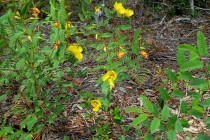
Partridgepea is often used as a wildlife forage because of the variety of species that feed off of the plant.
This is a friendly reminder that the Rice Field at Delta Research and Extension Service in Stoneville, MS will be tomorrow (July 31, 2012). Registration at Capps Center- 2:00 pm. Rice Market Outlook presentation by Milo Hamilton –
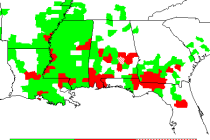
Additional soybean rust has been detected in MS as of last Thursday. At present, 5 counties (George, Issaquena, Jefferson, Pearl River, Pike) contain extremely light soybean rust infections in either commercial soybean fields (George, Jefferson, Pike) or in soybean sentinel plots (Issaquena, Pearl River).
There is some late-planted Mississippi corn which has not reached physiological maturity. This corn may have its yield reduced somewhat by severe problems or stress. Included is a chart which may help assess potential corn yield reduction or risk.
Bollworm counts plateaued throughout the state this week after rising the last two weeks. Bollworm larvae can be found in most susceptible crops, but pressure is still somewhat light compared to recent years. Tobacco budworm and beet armyworm pressure remains low.
Written by: Blake Edwards, Tom Eubank and Jason Bond Coffee Senna Family: Caesalpinia Scientific name: Senna occidentalis Synonyms: Bricho, Coffeeweed, Septicweed Coffee senna is an erect, summer annual plant that has alternate and compound leaves along the stem with opposite
Corn harvest will be upon us much sooner than normal and expectations are generally much higher than recent years. However, we still need to get this corn crop out of the field and safely deliver it to market. Methods to successfully harvest your corn crop may vary depending on several factors.
Numerous foliar diseases in our soybean production system are being observed. Frogeye leaf spot, aerial blight, Cercospora blight, and southern blight have been observed on numerous acres at this time.
This year started out with most folks expecting higher than usual bollworm numbers due to the mild winter. Couple that with increased corn acres and the perfect storm was thought to be brewing. This is why entomologists get “shifty†when
Southern rust continues to be a topic of conversation throughout the MS corn production area. Presently, the disease can be observed at low levels in a patchy distribution throughout the Delta. However, there are likely some fields that contain hot spots of the disease. Scouting continues to be necessary in situations where a fungicide application could be beneficial. But, the necessity to apply a fungicide will be dependent on several important variables.