Weed of the Week: Cutleaf Evening-primrose
Key identifying characteristics of cutleaf evening-primrose are the distinctive white mid-vein found on most leaves and a reddish base when cut with a sharp knife near the soil line.
Henbit is native to Europe and Asia but can be found throughout the United States. It is common in crop fields, roadsides, pastures, and lawns throughout Mississippi.
For the first time, strobilurin-resistant frogeye leaf spot was confirmed in MS during the 2012 season. Numerous states in our region have previously confirmed the presence of the resistant fungus.
As we begin to gear up for wheat planting there have been several questions regarding the use of insecticide seed treatments. We have been testing insecticide seed treatments in wheat for several years and have seen a positive response in nearly every case.
Two new insecticides from Valent recently received federal labels for use in rice. The state approval is still pending, but expected soon. The insecticides are Belay and Nipsit INSIDE. Both of these insecticides have the same active ingedient, clothianidin.
Identifying features of annual bluegrass are its light green color, low and clumping growth habit, open leaf sheath, and lack of hairs.
Downy brome can be problematic in some areas in winter wheat, pastures, and also in alfalfa.
Cheat is a tufted, erect, winter annual grass species that is native to Europe. Cheat prefers open areas with full sunlight, such as cultivated fields, roadsides, and pastures.
Italian ryegrass plants germinate from fall through early spring, are highly competitive, and grow rapidly in the winter and early spring months.
Texas millet is native to the southern United States and can be found in crop fields, pastures, roadsides, and untended areas in Mississippi.
Description and symptoms. Yesterday I looked at some defoliating fields in the greater Aberdeen vicinity. The vines looked like someone had used a set of hedge shears to remove the foliage from between the rows and thin it in the
Many diseases of soybean can produce a symptom of interveinal chlorosis. Stem canker, sudden death syndrome, Phytophthora root rot, southern blight, and several other less common diseases in the MS production system can all produce symptoms on the uppermost leaves that appear similar to SDS. However, disorders can also produce the same symptom and are oftentimes readily misdiagnosed at the field level.
Plant pathogens require a specific set of factors to occur at the same time for disease to begin. More often than not diseases require a prolonged conducive environment before the pathogen can produce observable symptoms.
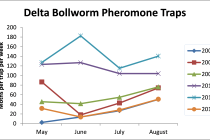
Bollworm trap counts dropped slightly from the previous week in the Delta and Central MS regions while staying about the same in the Northeastern MS region. Tobacco budworm counts also dropped back some this week while beet armyworm counts were
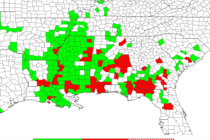
Over the past six weeks soybean rust has been detected in numerous soybean fields throughout Mississippi. Even though it appears that a large number of counties have soybean plants infected with the disease, at present only low levels of soybean
Southwestern cupgrass has become an increasing problem in recent years in Mississippi.
Soybean harvest has begun in several places around the state. According to the USDA Agricultural Statistics Service in Mississippi, 34% of the soybean acreage is dropping leaves and 9% has been harvested. Yield reports at this point are optimistic in
As of Sunday evening, it appears that Tropical Storm Isaac will slow, turn into a hurricane, and hit our Gulf Coast sometime Tuesday. Rainfall amounts are forecast in inches below I-20 and tropical storm conditions are expected to prevail for
This article lists those wheat varieties which have demonstrated superior productivity in the MSU Wheat and Oat Variety Trials and summarizes their characteristics. This impartial information should help you better assess how many variety traits potentially work to affect wheat performance on your farm next season.
Cotton harvest aid applications are beginning to go out on some of the earliest planted and/or burnt up cotton in several areas throughout the state. As most know, there are several methods that can be used to time defoliation applications;
Broadleaf signalgrass is widely dispersed throughout the southeastern region of the United States.
Foliar disease in the soybean crop continue to be observed throughout MS. Presently, soybean rust has been detected in 11 counties, with Lowndes, Noxubee, and Winston being the most current finds (8/21/2012). In addtiion, frogeye leaf spot and Cercospora blight continue to be observed across a greater number of acres.
Mississippi producers planted 65K acres of grain sorghum this year, up from 52K acres in 2011, and 12K acres in 2010. Grain sorghum traditionally in MS has been considered a “step child†crop that went on the worst dry land
Tobacco budworm catches were up sharply this week, especially in the northern and central Delta region. Bollworm catches were slightly higher in all regions of the state. With higher tobacco budworm catches, the proportion of worms that are budworms in
At this point in the growing season, those with irrigation capabilities are looking at their crop to decide how much additional water it will take to finish things off. Scattered rains over the last few days have helped make this