Rice Stink Bug Update
As some of the rice in Mississippi is starting to approach head emergence within the next few weeks, I wanted to give a brief update on rice stink bug populations that we are seeing across the Delta.

As some of the rice in Mississippi is starting to approach head emergence within the next few weeks, I wanted to give a brief update on rice stink bug populations that we are seeing across the Delta.
The DREC will be holding two separate field days, one for corn and soybean on July 19 and one for rice on July 31.
When glyphosate was effective on most weeds, we were in a period of “weed controlâ€. However, over the last few years since glyphosate-resistant weeds have become so prevalent, we have entered a period of “weed managementâ€.
Sprayer cleanout after a herbicide application is a critical component to a successful herbicide application.
Over last week or so, calls have become to trickle in on sick rice after the flood has been established. In most of these cases, the rice does not want to grow with the fertilizer and a flood on it. After inspecting these fields, signs of herbicide damage are evident on the foliage. When most of the calls come in, the producers believe that it is either a fertility, insect or disease issue. However, those issues generally occur in patches or spots where some areas are worse than others. Herbicide drift usually occurs across the whole field with one side being worse than the other. Also, rice that is on the levee can give you a general direction in where it came from.
A good rule of thumb is that the crop should be weed-free for the first four to six weeks following emergence to avoid yield loss.
Rice Acreage: On March 30th USDA estimated that Mississippi will plant 135,000 acres of rice. That is down 16% from 2011 and the lowest acreage since the mid 1970’s. Talking with producers and seed retailers, I would estimate that Mississippi acres will be closer 100,000 acres. There are a lot of farmers across the delta that will not be planting any rice and it has been over 40 years since they have done that. Stagnant rice prices and high urea prices have not encouraged any additional plantings. The recent upswing in urea prices will not have a significant impact on rice acres.
The 2012 Mississippi Agricultural Industry Council and Mississippi Seedsmen’s Association convention will be held again at beautiful Perdido Beach Resort in Orange Beach, Alabama, on July 24-July 28, 2012. This will be our 19th year at Perdido Beach Resort.
A problem that has become increasingly common in Mississippi and across the Midsouth over the last two years is corn injury from fomesafen (Flexstar, Flexstar GT, Prefix, Reflex) carryover.
USDA released their April World Agricultural Supply and Demand Estimates (WASDE) report this morning and inside was one unforeseen surprise. Corn carry-over (the amount we keep in bins and elevators from one year to the next) was unchanged from the March estimate
Encouraging farmers to plant rice this year has been a hard sell. The rice industry is facing multiple issues that have put downward pressure on acres resulting in what will be one of the smallest rice acres since the early
USDA released their annual Prospective Plantings report Friday morning (Mar 30). The report reveled that corn is the big gainer in terms of acres planted this year versus last year. Corn acres across the U.S. are expected to jump by
Paraquat is a critical component of an at-planting herbicide application.
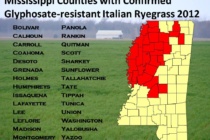
The severity of the glyphosate-resistant (GR) Italian ryegrass problem in Mississippi has varied from year to year. This year has been the worst year since the initial confirmation in 2005, and GR Italian ryegrass is spreading.
Below is a short list of apps that I have found helpful in the agriculture world. This list is by no means the only ones available or useful. These are just the ones I found to be pertinent and can help your overall productivity. I am sure there are more apps out there that could be beneficial, but I may not have discovered them yet. As always, I welcome your comments.
USDA released their monthly World Agricultural Supply and Demand Estimates report early Thursday morning (Feb 9, 2012). The report states that current marketing year (2011/12) corn, soybean and wheat ending stocks are projected at 801, 275 and 845 million bushels,
This is a brief review of the many agronomy, breeding, pest management, soil fertility, and water conservation research projects funded by the Mississippi Rice Promotion Board.
You are invited to the 2012 Delta Ag Expo. The Delta Ag Expo provides farmers and others interested in agriculture an opportunity to see the latest technology in agricultural products, services, and information. You will have the opportunity to view agricultural exhibits and talk with extension and research personnel and get up-to-date information for planning your crop year.
USDA released it’s monthly projections for U.S. and global agricultural supply and use this morning. According to the market reaction the report was most shocking for soybeans. Both crushings and export use are forecast at 1.625 and 1.3 billion bushels
I would like to thank everyone for attending the Rice Short Course. At much request, I have included copies of the presentations made at this short course. Also, I have attached a preliminary copy of the Rice Variety Trial Booklet.
The Mississippi Chapter of the American Society of Agronomy will hold it’s annual meeting on Wednesday, November 16 at the Grenada County Extension Office. The program will being at 9 a.m. and will conclude at 3:30 p.m. CCA continuing education
USDA released their monthly Crop Production and World Agricultural Supply and Demand Estimates report yesterday morning (Wednesday, Oct. 12). The report was not a big surprise to any crop, but could be viewed as slightly bearish for corn, cotton, and
This video update talks about harvest progress, potential heat sterility problems, and rice stinkbugs.
Cotton acreage and yield were projected higher in this month’s World Agricultural Supply and Demand Estimates (WASDE) report released this morning by USDA’s World Agricultural Outlook Board. The increase resulted from field data as opposed to surveys or trend analysis based on

© 2023 Copyright Mississippi Crops. All Rights reserved.
