6/14/2012 Ditch Bank Survey
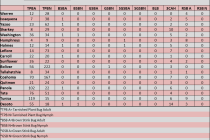
Click below for results of this weeks ditch bank survey


Over the past several weeks several phone calls have inquired about the specifics on timing of fungicide application in soybean. Over the past decade, the majority of the fungicide trials conducted in MS have suggested that an R3/R4 fungicide applied in the absence of disease provides not only excellent yield-loss prevention but in some cases an economic return.
The DREC will be holding two separate field days, one for corn and soybean on July 19 and one for rice on July 31.
The United States Department of Agriculture’s World Ag Outlook Board released their monthly supply and demand estimates report earlier this morning. The report was the second round of forecast for the current summer (new) crops, which is the 2012/13 marketing
The biennial North Mississippi Research and Extension Center Agronomic Row Crops Field Day will be held at the Lee County Agri-Center, Magnolia Conference Center, Highway 145 South of Verona, on Thursday, August 9, 2012, from 8:00 a.m. to 1:30 p.m.
Plant bug sprays are going out this week but overall numbers have not been as high as expected to date. This can change rapidly as plant bugs begin to move into fields from wild host plants. Click to Enlarge
Several soybean fields around the state have unfortunately been impacted from hail associated with recent storms. The big question in these cases is whether or not to replant. This is always a difficult question to answer. Several things need to
When glyphosate was effective on most weeds, we were in a period of “weed controlâ€. However, over the last few years since glyphosate-resistant weeds have become so prevalent, we have entered a period of “weed managementâ€.
Sprayer cleanout after a herbicide application is a critical component to a successful herbicide application.
Over the past week a few soybean fields in the Delta have been observed with the characteristic symptoms and signs of southern blight. Typically, southern blight is a disease of rare occurrence; however, the prevailing environmental conditions seem to be causing added stress and increasing the incidence of this particular disease.
Over the last couple of weeks I have had numerous calls about caterpillar pest in young soybeans. Most of these have been concerning beans that are still in the vegetative stages (V2-V5). The species that are being found are bollworm, yellowstriped armyworm, green
The insect scout schools for 2012 have been set. At each scout school we will go over biology, thresholds, and scouting techniques for each of the major pests of cotton, soybean, and corn. This is a great refresher for the
USDA released their monthly World Agricultural Supply and Demand Estimates report (WASDE) early this morning (May 10). The report is the first to highlight the new -2012- crop. The report revealed more corn and cotton available than analysts expected, while
An agronomic crops field day will be held at the R.R. Foil Plant Science Research Center in Starkville, MS on July 19, 2012 from 9 to 11 a.m. The field day will begin at 9 a.m. with field tours concluding
A good rule of thumb is that the crop should be weed-free for the first four to six weeks following emergence to avoid yield loss.
Environment is the key component in the expression of every plant disease. Especially when considering the occurrence of seedling diseases we typically have a situation in place where inoculum is present in the soil, more than likely in high quantities,
Mississippi State University has named Dr. Jason Krutz as Extension/Research Irrigation Specialist at the Delta Research and Extension Center
The 2012 Mississippi Agricultural Industry Council and Mississippi Seedsmen’s Association convention will be held again at beautiful Perdido Beach Resort in Orange Beach, Alabama, on July 24-July 28, 2012. This will be our 19th year at Perdido Beach Resort.
Sentinel plots will continue to be used to monitor for yield-limiting diseases throughout MS during the 2012 season. Even though in the past sentinel plots have more typically been used to monitor for the presence of soybean rust, the plots will be used to monitor for all economically important soybean diseases.
A problem that has become increasingly common in Mississippi and across the Midsouth over the last two years is corn injury from fomesafen (Flexstar, Flexstar GT, Prefix, Reflex) carryover.
USDA released their April World Agricultural Supply and Demand Estimates (WASDE) report this morning and inside was one unforeseen surprise. Corn carry-over (the amount we keep in bins and elevators from one year to the next) was unchanged from the March estimate
Using herbicides with different modes of action is an excellent resistance management tool for glyphosate-resistant Palmer amaranth.
USDA released their annual Prospective Plantings report Friday morning (Mar 30). The report reveled that corn is the big gainer in terms of acres planted this year versus last year. Corn acres across the U.S. are expected to jump by

© 2023 Copyright Mississippi Crops. All Rights reserved.
