How much Nitrogen have I Lost from Saturated Soils?
Abundant rainfall has soaked corn fields for extended time during April and late May, exposing nitrogen fertilizer to potential loss. This article gives guidelines for estimating potential N loss.
As a lot of our corn approaches tassel, issues associated with tire traffic soil compaction are becoming more evident. This article discusses the consequences.
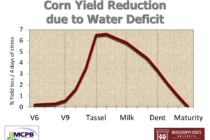
The recent stretch of dry weather has prompted much conversation about the proper time to initiate irrigation for corn. This scenario usually generates a lot more anxiety than necessary because early season wilting is certainly not something we are very accustomed to.
Abundant spring rainfall can create havoc with corn nitrogen management by delaying fertilizer application and also promote massive nitrogen loss. These strategies should help enhance crop response during challenging conditions.
For the most part the Mississippi wheat crop is clean with regards to foliar diseases. However, some important issues are occurring that need to be addressed with regards to Fusarium head blight, stem maggot feeding, and general herbicide injury as these three issues can easily be confused with one another at the field level.
Strong markets are driving Mississippi growers to plant a lot more grain sorghum than what could have been, considering the recent development of Sugarcane aphids as a threat to sorghum production. This article gives guidelines for getting your sorghum crop off to a good start.
Much like the last 2-years, as rains delay corn planting progress, more concerns arise regarding whether you will have ample opportunity to plant your corn crop in a suitable time window. This article states new guidelines for late corn plantings based upon recent MSU research.
This effort lists those grain sorghum hybrids which have demonstrated superior productivity in the MSU MAFES Grain Sorghum Hybrid Trials and neighboring University trials. This information should help you pick well-suited sorghum hybrids for Mississippi.
Environmental factors play a substantial role in nitrogen fertilization for wheat producers in the Mid-south. This article gives guidelines for getting optimal wheat response to your nitrogen fertilizer.
On February 5th 2015, Mississippi State University will host the third annual Future of Agriculture Graduate Student Competition. The competition will be open to M.S. and Ph.D. students working in production agriculture. Over the last several years, there has been a
Find attached the agenda for the 42nd Annual Delta Ag Expo to be held in Cleveland, MS on Wednesday, January 21 and Thursday, January 22, 2015. We hope to see you in attendance at the Bolivar County Ag Expo Center.
Metribuzin is an important herbicide for controlling numerous weed species in wheat. However, wheat varieties may differ in tolerance to metribuzin. These are the results from our evaluation of wheat varieties included in the MSU Wheat Variety Trials. This should help you better assess potential for wheat crop injury.
The MSU Corn Hybrid Demonstration Program evaluates superior corn hybrids from numerous seed companies who market corn in Mississippi. Our objective is to provide you more opportunity to evaluate premier corn hybrids and substantially supplement the independent and unbiased information gathered in the University Hybrid Trials.
This effort lists those corn hybrids which have demonstrated superior productivity in the MSU Corn for Grain Hybrid Trials. Approximately 80 corn hybrids representing the vast majority of seed companies in the Mid-South participate in the MSU hybrid trials. This information should help you better assess corn hybrid productivity and improve your success in future seasons for either irrigated or dryland culture.
This publication lists those wheat varieties which have demonstrated superior productivity in the MSU Wheat and Oat Variety Trials and summarizes their characteristics. This impartial information should help you better assess wheat varieties which are best suited for your farm.
Many growers in the Mid-South apply a herbicide shortly prior to sorghum harvest to facilitate combine efficiency and suitable grain moisture. This season, this issue is even more critically important because of severe harvest problems potentially created by White Sugarcane aphid infestation. This article will discuss appropriate timing and potential outcome of such harvest aid applications.
Southern corn rust continues to be observed throughout MS. We continue to receive calls regarding late fungicide applications (> R4/R5) to reduce yield losses attributed to southern rust. Numerous myths regarding the disease have been widely spread throughout the MS corn production area including death of a corn plant in as fast as 7 days following southern rust infection and lodging as a result of heavy southern rust infection.
The North Mississippi Research and Extension Center’s Agronomic Row Crops Field Day on Thursday, August 7 will present the latest research to the area’s row-crop farmers and consultants. The field day will be from 8 a.m. to 1:30 p.m. at the Lee County Agri-Center Magnolia Conference Center on Highway 145 South in Verona.
“It ain’t over till it’s over!” Amazing as it seems, several producers have not laid poly pipe. After the five plus inches of rainfall we received last week, some producers are questioning the need to lay pipe this late in
Considering the abundant rainfall during June and the corn crop progressing closer toward maturity, many are wondering whether additional irrigation may even be needed. This article discusses how to make that and other late-season irrigation decisions.
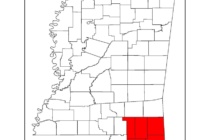
Foliar corn diseases continue to be observed throughout the MS corn crop. Common rust, gray leaf spot, northern corn leaf blight, and southern corn leaf blight are all present at low levels throughout the Delta. As of Wednesday (June 25, 2014), southern corn rust had only been observed in southeastern MS (Forrest, George, Greene, Jackson, Perry, and Stone counties).
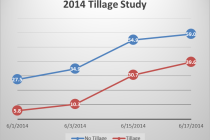
The importance of soil moisture sensors is becoming more evident as we continue forward this growing season. Today (Monday, June 16th), we received a call regarding sensor readings that were assessed early this morning. The following are the data discussed in this scenario.
More and more corn growers are applying various management inputs around tassel stage in order to improve efficiency and corn productivity. This article discusses how crop physiology affects the appropriate timing and crop response.
A corn, cotton, peanut, and soybean field day is scheduled for June 17th at the Delta Research and Extension Center in Stoneville, MS. The general theme of the field day will include pertinent information for mid-season row crop issues.
Considering the abundant rainfall we experienced during April and typically have, it is usually very important to optimize nitrogen fertilizer management. This newsletter discusses best management practices for corn nitrogen fertilization. These recommendations reduce the risk of nitrogen loss and can improve crop response when wet weather is prevalent during the spring.