Harvest Aid Options in Soybean
While weeds can create problems for harvest equipment, many producers see the benefit of a harvest aid in creating a more rapid and efficient harvest in the absence of weeds
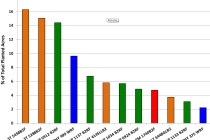
The United States Department of Agriculture – Agriculture Marketing Service recently released their 2013 cotton varieties planted report. Based on their numbers, ST 5458 B2F, ST 5288 B2F, DP 0912 B2RF, and PHY 499 WRF were the four most popular
Over the last month we have had numerous questions about terminating stink bug applications in late season soybeans. Typically we manage stink bugs until near harvest but there are several things to consider before making an application to control stink bugs in beans beyond R6 growth stage.
A common question that I have received from numerous consultants over the last several days is as follows. Hey don’t hammer me, but what happens if we mistakenly burned our corn stubble after we spread fall mixed good fertilizer and
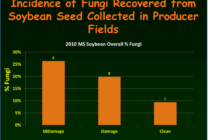
Numerous questions have come in over the past few weeks regarding proper grain storage. Maintaining moisture below 15% is extremely important to reduce the likelihood of fungal growth. However, not all fungi that develop on harvested grain are problematic and toxin production is not something that can occur overnight. Even though fungi such as Aspergillus flavus can produce a green fungal growth on harvested grain not all fungi that grow on grain can be considered to be A. flavus.
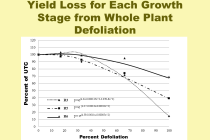
It has often been said that cotton defoliation is more art than science. This thought is further nurtured when harvest aids perform differently under seemingly similar conditions. As with any pesticide application, many factors come into play when determining harvest
Red crown rot has been identified in additional fields in east MS throughout the 2013 season. Prior to 2013 only two counties had been identified as having red crown rot. However, three additional counties have been added this season (Clay, Newton, Union). Red crown rot symptoms can be misdiagnosed as several other diseases, including sudden death syndrome (SDS).
Determining when to terminate irrigation in soybean can be difficult. When making this decision, the goal is to make sure that adequate soil moisture is available to ensure that the soybean seeds reach maximum size. Terminating irrigation too soon can
Foliar diseases of soybean continue to be observed throughout the MS soybean production system. Over the past week additional counties containing soybean rust have been observed throughout the state. Stay tuned to information on the Crop Situation Blog regarding additional counties with soybean rust infected plant material should management suggestions change.
Soybean looper has started to show up in soybean and a few applications have started in some fields. We have several good options to manage soybean looper and all of them should be considered. Belt has become the go to insecticide for looper control in a lot of situations over the last couple of years.
Now that early planted beans are drying down quickly and insect pressure is increasing on late planted soybeans in some areas, many are asking when it is safe to quit spraying insect pest in soybeans. For most pest in soybean
I have looked at several fields over the last couple weeks that should be considered safe from yield loss from insect pest. Keep in mind that termination rules for insects in cotton do not mean the crop is “bug proof” but
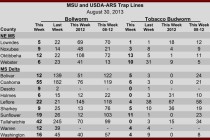
Bollworm moth trap counts were lower at nearly every location this week compared to last week, indicating that bollworms are primarily in the larval stages at this time. Tobacco budworm trap counts were also low, so if a field is clean, new infestations
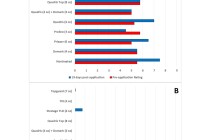
Numerous questions over the past few weeks regarding how well certain fungicide chemistries are managing frogeye leaf spot. Attached please find preliminary rating data from Starkville and Stoneville on how well particular products are managing observable symptoms of frogeye leaf spot. Additional data to follow as we continue to rate plots.
Two upcoming peanut field days offer the latest research recommendations and a chance to see some research/demonstration plots. The first field day will be held in south Mississippi, at Lucedale, the other in north Mississippi, at Clarksdale. Lucedale The Lucedale
Terminating soybean irrigation too early can result in lower yield due to decreased seed size. At the same time, irrigating when the crop no longer needs water can be a waste of time and resources. On Friday, August 30, 2013
During the 2011 growing season Chris Main, Bob Hayes, Tom Barber, Dan Reynolds, and myself put together a defoliation guide to cover Tennessee, Arkansas, and Mississippi. The folks at LSU have a similar guide for cotton in that state that
The time of year has arrived that growers are getting the itch to terminate irrigation applications in cotton. In a normal year, cracked bolls are present at the present calender date; however, cracked bolls are currently the exception rather than
As is typical for this time of year, bollworm pheromone counts were higher this week, particularly in the Delta. These moths are presumably those that developed in corn ears, and will now be seeking out hosts for another generation, likely
Numerous diseases continue to be reported from throughout the MS soybean production area. Frogeye leaf spot continues to be the main foliar disease observed. Additional soybean rust was reported from Adams County this past week. However, since low levels of the disease continue to be reported the suggestion remains that farmers wait and watch the available information and allow soybean to get as close to reproductive developmental stages before making a fungicide application.
This last week I found early leaf spot in the Greater Columbus, Mississippi area. For information and images on how to identify early leaf spot, please see: https://www.mississippi-crops.com/2013/08/12/early-leaf-spot-of-peanut/ and https://www.mississippi-crops.com/2012/09/05/early-leaf-spot-found-in-the-greater-aberdeen-area/ Early and late leaf spot are major defoliators of peanuts
Bean leaf beetle numbers have been much higher than they have been in the last couple years. We have actually made bean leaf beetle targeted sprays on a number of acres this year. Yield loss is caused by defoliation and
Trap counts were generally steady to slightly lower this week compared to last week for both bollworm and tobacco budworm. As has been the case all year, counts are higher than in 2012 but slightly lower than long-term average catches.
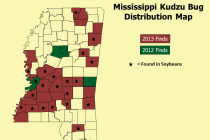
Seems like we are adding new counties every week. We are now at 24 counties total with 16 of those having kudzu bugs found in soybeans. At this time we have actually treated a field or two for kudzu bugs in
Synopsis: Is caused by a fungus, Cercospora arachidicola. Defoliates infected leaflets fairly quickly. Is one of the reasons, along with late leaf spot, for the development of the traditional two week spray schedule in established peanut growing areas (see Figure