2015 Row Crop Short Course
The 2015 Row Crop Short Course will be held at the Cotton Mill Conference Center near the campus of Mississippi State University on November 30, December 1, and December 2 2015. Please note that this is a new venue as

The 2015 Row Crop Short Course will be held at the Cotton Mill Conference Center near the campus of Mississippi State University on November 30, December 1, and December 2 2015. Please note that this is a new venue as
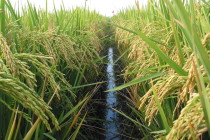
The 2015 Delta area/Bolivar Co. Rice Meeting will be held at the Bolivar Co. Extension office on November 5, 2015. Mississippi rice producers, industry professionals, and other interested parties are invited to listen to presentations from MSU research and Extension
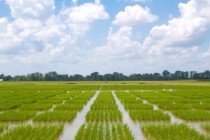
Find below the Preliminary version of the 2015 On-Farm Rice Variety Trial. During 2015, small plot rice variety trials were conducted near the following locations; Choctaw, Clarksdale, Hollandale, Ruleville, Shaw, Stoneville, and Tunica. Variety trial data is presented segmented by
This publication lists those wheat varieties which have demonstrated superior productivity in the Mississippi Wheat and Oat Variety Trials and summarizes their characteristics. This impartial information should help you better assess wheat varieties which are best suited for your farm.
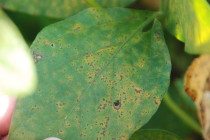
Late-season soybean rust observations occur on almost an annual basis. Even though the majority of the soybean crop has escaped yield loss as a result of soybean rust again for the 2015 season, determining the extent of the disease in MS as well as potential locations where the fungus could overwinter continue to be an important part of the monitoring/scouting program. At present (9/22), soybean rust has been detected in 41 counties.

The Mississippi Chapter of the ASA will hold their annual meeting on Wednesday November 4, 2015 at the Grenada Co. Extension Office. Certified Crop Adviser CEU’s will be available as well as recertification credits for Category X and IA applicator
Although picking has started in the south Delta and some defoliation applications have already been made, a large number of applications will be made in the next week to 10 days. Cooler temperatures over the weekend caused some folks to
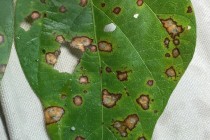
A field training regarding late-season soybean diseases will be held in Monroe County, MS on Tuesday, September 15 beginning at 5:30 pm and ending with a meal at a local restaurant. The diseases discussed will likely include: charcoal root rot,
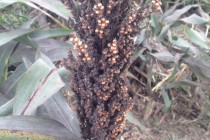
Some grain sorghum still remains to be harvested around the state and sugarcane aphid populations have remained high in a lot of areas. We had a post by Erick Larson and Angus Catchot a couple of weeks ago here about use of harvest
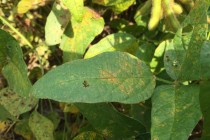
Soybean diseases continue to be observed throughout the MS soybean production area. The number of counties (13, as of 9/4/2015) exhibiting soybean rust has increased over the past several days. However, low levels of infection have been observed at most locations. Frogeye leaf spot, Cercospora blight, target spot, and stem canker also continue to be observed.
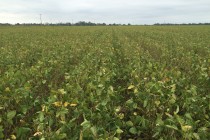
Several calls have come in over the last week regarding soybean harvest aid options for various scenarios. In some cases, fields have been observed with varying degrees of maturity. In these situations, the majority of the pods observed across the
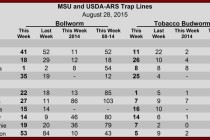
Bollworm trap catches remained similar to last week, which is somewhat lower than average for this time of year. Tobacco budworm trap catches were somewhat higher this week. As most crops are now beyond the vulnerable window for damage from
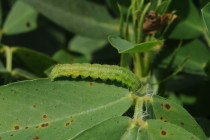
We have had numerous calls over the last 2 weeks about caterpillars in peanut from all around the state. In every case, the calls have involved a complex of multiple species including bollworm/tobacco budworm, cutworms, armyworms, saltmarsh caterpillar, loopers, and rednecked peanut worm.
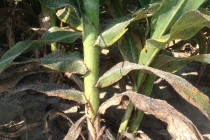
In 2014 we saw two brief time periods of less than satisfactory control with Transform on sugarcane aphids in grain sorghum across a broad geography. At the time we were mixing a lot of pyrethroids with Transform, so initial thoughts were that
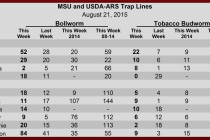
Bollworm moth trap catches were slightly higher in most counties this week but are generally lower than average counts for this time of year. Tobacco budworm moths continued to be caught at relatively low levels. Continue to monitor susceptible fields
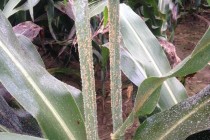
The following is a short video clip showing sugarcane aphids building on the flag leaf of mature grain sorghum. This will have to be addressed in this field to avoid complications with harvest equipment. Options are Transform at .75 –
An agronomic crops field day will be held at Stovall farms, west and north of Clarksdale on Oakhurst Stovall Road. The field day will be held at Mr. Pete Hunter’s farm shop beginning at 10 am. MSU Extension Specialists will be present to discuss topics in corn, cotton, grain sorghum, peanut, rice and soybean.
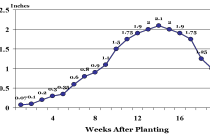
Water is an issue that has been on everyone’s mind this year and for many of us, it has not been our friend. It was wet early, keeping us from getting in the field for land preparation and planting. Since
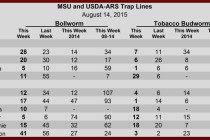
Bollworm counts fell some for the second consecutive week, a clear indication that the generation that developed in corn has mostly emerged and we are now in the larval stage of the next generation. Tobacco budworm were similar to the
As we progress through the second week of August and white flowers continue to climb cotton stalks throughout the state, several calls have come in regarding irrigation termination in cotton. Our general recommendation is as follows: Furrow irrigation: Terminate irrigation
Many growers in the Mid-South apply a harvest aid to sorghum to facilitate combine efficiency. Although it is possible to harvest sorghum without using a harvest aid, understanding the benefits of usage, along with adverse consequences, will help you implement a practical plan that will enhance your sorghum harvest.
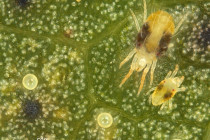
There has always been a struggle with properly defining the correct cutoff for spider mites in cotton in the Mid-South region. For years we always loosely considered Node Above White Flower 5 (NAWF5 = Cutout) and 650 heat units the
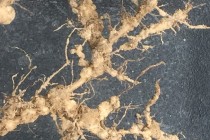
Soybean disease continues to be observed throughout the MS soybean production system. Frogeye leaf spot, root-knot nematode, and a first report of soybean rust occurred over the past 7 days. In addition, widespread fungicide phytotoxicity has been observed in numerous fields due to the hot and humid conditions.
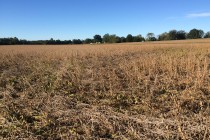
There have been numerous calls and questions about Dectes Stem Borer over the last few years. It seems that numbers are increasing each year. This is not surprising when you consider the biology of the insect coupled with an increase in soybean acres in MS.
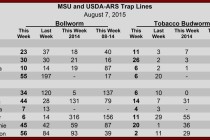
Bollworm pheromone trap counts finally started to go down a little this week, likely signalling the end of the generation that passed through corn. However, enough moths were still caught to potentially cause economic losses in some areas. Tobacco budworm

© 2023 Copyright Mississippi Crops. All Rights reserved.
