Back to homepage

3. By Editor

Kudzu Bug Finds in Mississippi Increasing

Kudzu Bug Finds in Mississippi Increasing Updated

🕔16:00, 17.May 2013

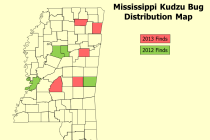
In 2012 Kudzu bugs were found in four counties in Mississippi on Kudzu.  All finds were along major highways suggesting they “hitchhiked” in on vehicles. The counties were Warren, Lauderdale, Montgomery, and Carroll. In the last 2 weeks we have

Read Full Article▸
Do Insecticide Seed Treatments Provide any Value on Late Planted Soybeans?

Do Insecticide Seed Treatments Provide any Value on Late Planted Soybeans? Updated

🕔15:39, 17.May 2013

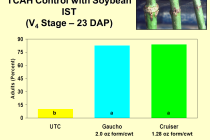
Due to the rain and cold weather this spring a much larger percent of the soybean crop will be planted later than normal. There have been several questions lately about whether or not we should still include an insecticide seed

Read Full Article▸

Thrips in Cotton and Peanuts Updated

🕔15:27, 17.May 2013

I have been asked several times over the last week about the need for thrips control now that we have more optimal planting conditions. This is a good question and I will attempt to provide some valuable insight about thrips control in both cotton and peanuts.

Read Full Article▸

Soybean Seedling Issues: Seedling Disease Versus Herbicide Injury Updated

🕔19:57, 14.May 2013

Within the past week to 10 days, numerous fields have been diagnosed as having “Pythium seedling disease”. In most cases, herbicide injury has resulted in fields appearing to have an uneven stand as a result of seedling disease. Rarely would a seedling disease be responsible for large acreages of dead seedlings. More than likely, a combination of events have occurred to cause the appearance of seedling disease. Preemergence herbicides, cool temperatures, excessive rainfall following planting immediately prior to emergence, light soil texture, and herbicide injury on stressed soybean seedlings have all compounded the stressful situation.

Read Full Article▸

How to Estimate Nitrogen Loss resulting from Saturated Soils Updated

🕔18:42, 14.May 2013

Persistent rainfall has periodically saturated corn fields for several weeks this spring, prompting questions regarding potential nitrogen fertilizer loss. This article gives guidelines for estimating potential N loss.

Read Full Article▸

Wheat Leaf Topics and Physiological Leaf Spotting Updated

🕔13:54, 11.May 2013

Oftentimes dealing with foliar wheat diseases can be a confusing topic. More often than not, physiological leaf spotting, or genetic leaf spot, can be observed in most wheat fields after flowering stages. However, the leaf spot symptoms are occasionally misdiagnosed as early leaf rust symptoms. But, rarely have I observed a disease epidemic in a situation where the specific “flecking” symptoms are regularly observed.

Read Full Article▸

Cotton Replant Costs Updated

🕔09:11, 11.May 2013

Very little cotton has been planted so far this year given the seemingly weekly rainfall.  What little cotton has been planted has struggled due to cool temperatures, water saturation, etc.  In some cases, fields are not going to emerge to

Read Full Article▸

Transform WG Insecticide from Dow Recieves Label for Cotton Updated

🕔12:42, 10.May 2013

Earlier this week Transform WG insecticide from Dow received a full Section 3 label for use in cotton.

Read Full Article▸

Wheat Disease Update: May 4, 2013 Updated

🕔15:32, 4.May 2013

Scattered reports of wheat diseases have been made over the past two weeks. Limited leaf rust, stripe rust, and Septoria leaf blotch can be observed in some wheat fields. In addition, in some situations bacterial leaf streak can be readily observed on flag leaves in some limited situations. In some cases, bacterial leaf streak and Septoria leaf blotch can appear similar to one another. In most cases, Septoria leaf blotch can be observed in the lower canopy and likely will not move up the plant to the flag leaf. However, bacterial leaf streak can be more readily observed on flag leaves in some fields.

Read Full Article▸

Stink Bug Numbers Increasing in Heading Wheat Updated

🕔07:59, 30.Apr 2013

I am starting to get numerous calls about stink bugs in heading wheat. It is not uncommon to find stink bugs in wheat after head emergence.  However, it takes extremely high numbers to cause economic damage to heading wheat. With this

Read Full Article▸

Brown Stink Bugs Showing Up In Small Corn Updated

🕔07:42, 30.Apr 2013

Stink bugs damage small corn by feeding through the whorl or side of the stem hitting the growing point which either causes “dead heart” or severely stunts the plant. Severely stunted plants may not die but essentially become a weed. In many cases, corn that has been fed on without hitting the growing point will recover. Even if the growing point is not hit, in some situations where stink bugs feed through the stem you will see irregular growth.

Read Full Article▸

Are Early, Vegetative Fungicide Applications Beneficial for Enhanced Corn Production? (Part II: Impact of Fungicide on Greensnap) Updated

🕔21:13, 28.Apr 2013

During 2012 fungicide application trials were conducted at a field site west of Greenwood, MS. Following a major wind event that occurred early in June, excessive greensnap was observed in plots that had received V6 foliar fungicide applications. Plots were assessed to determine if fungicides could consistently alleviate the occurrence of greensnap compared to untreated plots.

Read Full Article▸

Are Early, Vegetative Fungicide Applications Beneficial for Enhanced Corn Production? (Part I: Yield) Updated

🕔17:07, 28.Apr 2013

Oftentimes, deciding whether or not to make a fungicide application to corn in vegetative growth stages is not based on disease. Rarely are foliar diseases an issue in vegetative growth stages (save for extremely rare situations). More often than not, the decision to apply a fungicide at a vegetative timing is based on the theory of “plant health”, or physiological enhancements to the plant as a result of the fungicide that have been difficult to replicate in all situations.

Read Full Article▸

Corn Replanting Guidelines and Management Issues with Wet Weather Updated

🕔14:16, 26.Apr 2013

Unrelenting rainfall continues to delay much field-related progress. This article gives suggestions for making corn replant decisions and keeping up with crop needs, such as nitrogen fertilizer application.

Read Full Article▸

Chase the Sprayer with the Planter Updated

🕔12:18, 26.Apr 2013

Historically, we have chased the planter with the sprayer to apply residual herbicides. This presents several potential problems…

Read Full Article▸

Corn Disease Calendar Updated

🕔14:45, 20.Apr 2013

Use the information contained in this blog post to aid in determining the specific disease in field corn. Scouting corn for the presence of disease is difficult and can be confusing since some foliar diseases appear similar to one another such as gray leaf spot and southern corn leaf blight. In addition, particular diseases are more important depending on the particular growth stage when they are encountered.

Read Full Article▸

Wheat Disease Update: April 20, 2013 Updated

🕔09:30, 20.Apr 2013

Wheat disease continue to be discussed throughout MS. Generally speaking, stripe rust has not been near the widespread threat this season as it was during the 2012 wheat crop. Scout wheat fields for the presence of diseased and relate this to the specific variety in each field when determining particular management alternatives. Keep in mind, the general cut off date for fungicides is Feekes 10.5.1.

Read Full Article▸
USDA Crop Progress and Condition Report for Mississippi

USDA Crop Progress and Condition Report for Mississippi Updated

🕔15:42, 15.Apr 2013

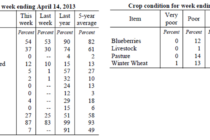
According to the National Agricultural Statistics Service in Mississippi, there were 2.7 days suitable for fieldwork for the week ending Sunday, April 14, 2013. Dry conditions during the first half of the week allowed for some fieldwork to be done. Wet conditions in the last half of the week slowed or stopped all fieldwork. Soil moisture was rated 40 percent adequate, and 60 percent surplus.

Read Full Article▸

Will cold and rainy weather impact seed treatments in corn and rice? Updated

🕔16:38, 5.Apr 2013

This is an important question right now with the weather conditions that we have had over the last few weeks. A considerable amount of corn and a little bit of rice has been planted over the last 3 to 4 weeks. In most of those fields, the crop has either just emerged or has not emerged yet.

Read Full Article▸

What is the Cut-off Date for Planting Corn? Updated

🕔22:07, 4.Apr 2013

As rains continue to delay corn planting progress, more concerns are rising regarding the appropriate “cut-off” date for planting corn. Recent MSU research gives a solid basis for addressing this question.

Read Full Article▸

IMPORTANT NOTICE: Tebuconazole Label Restrictions in Wheat Updated

🕔12:49, 2.Apr 2013

Please see the attached information regarding the use of products that contain tebuconazole to manage wheat diseases. Note that the label restricts the overall amount of tebuconazole that can be applied to wheat in any one season to 4 fl oz/A.

Read Full Article▸

Wheat Disease Update: March 30, 2013 Updated

🕔09:45, 30.Mar 2013

Stripe rust continues to be observed throughout scattered fields in the Delta. In addition, leaf rust was confirmed in isolated cases over the past week. Keep in mind that not all fields will require a fungicide application to prevent yield loss. Scout wheat fields at this time for stripe rust hot spots (small in size = less than 3 feet in diameter; to large in size = several trucks) and determine the wheat variety present before deciding on a fungicide application.

Read Full Article▸

Soybean Disease Monitoring: Soybean Sentinel Plot Update and 2013 Soybean Rust Fungicide List Updated

🕔13:35, 29.Mar 2013

As we move towards the soybean season we’ve included some information regarding the labeled fungicides for application to prevent yield loss as a result of soybean rust. Soybean rust was able to overwinter in several Gulf Coast states (AL, FL, LA). However, at present, soybean rust has not been detected on kudzu in MS.

Read Full Article▸

Wheat Disease Update: March 23, 2013 Updated

🕔11:38, 23.Mar 2013

Additional stripe rust has been detected throughout the MS Delta over the past two weeks. Scout fields for the presence of stripe rust to determine the extent of the infection in the wheat production area. Keep in mind that stripe rust will appear different on younger wheat plants still in the early vegetative stages than it does on more mature wheat plants.

Read Full Article▸

The Fungicides Updated

🕔14:50, 19.Mar 2013

Throughout the season many ag-related professionals ask questions about particular fungicides. More specifically, sometimes it can be confusing to determine if a particular product falls in the strobilurin class of fungicides or the triazole class of fungicides. The current update includes information to help determine the particular class of fungicides for strobilurin, triazole, and pre-mix products using fungicides labeled for application in soybean as an example.

Read Full Article▸