Weed of the Week: Partridgepea
Partridgepea is often used as a wildlife forage because of the variety of species that feed off of the plant.

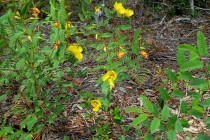
Partridgepea is often used as a wildlife forage because of the variety of species that feed off of the plant.
This is a friendly reminder that the Rice Field at Delta Research and Extension Service in Stoneville, MS will be tomorrow (July 31, 2012). Registration at Capps Center- 2:00 pm. Rice Market Outlook presentation by Milo Hamilton –
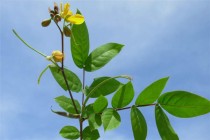
Written by: Blake Edwards, Tom Eubank and Jason Bond Coffee Senna Family: Caesalpinia Scientific name: Senna occidentalis Synonyms: Bricho, Coffeeweed, Septicweed Coffee senna is an erect, summer annual plant that has alternate and compound leaves along the stem with opposite
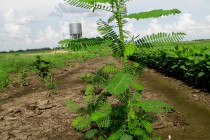
Late-emerging hemp sesbania is problematic at harvest due to its height, woody stem, and the fact that its black seed contaminate grain samples.
The DREC will be holding two separate field days, one for corn and soybean on July 19 and one for rice on July 31.
The biennial North Mississippi Research and Extension Center Agronomic Row Crops Field Day will be held at the Lee County Agri-Center, Magnolia Conference Center, Highway 145 South of Verona, on Thursday, August 9, 2012, from 8:00 a.m. to 1:30 p.m.
When glyphosate was effective on most weeds, we were in a period of “weed controlâ€. However, over the last few years since glyphosate-resistant weeds have become so prevalent, we have entered a period of “weed managementâ€.
Sprayer cleanout after a herbicide application is a critical component to a successful herbicide application.
Over last week or so, calls have become to trickle in on sick rice after the flood has been established. In most of these cases, the rice does not want to grow with the fertilizer and a flood on it. After inspecting these fields, signs of herbicide damage are evident on the foliage. When most of the calls come in, the producers believe that it is either a fertility, insect or disease issue. However, those issues generally occur in patches or spots where some areas are worse than others. Herbicide drift usually occurs across the whole field with one side being worse than the other. Also, rice that is on the levee can give you a general direction in where it came from.
A good rule of thumb is that the crop should be weed-free for the first four to six weeks following emergence to avoid yield loss.
Rice Acreage: On March 30th USDA estimated that Mississippi will plant 135,000 acres of rice. That is down 16% from 2011 and the lowest acreage since the mid 1970’s. Talking with producers and seed retailers, I would estimate that Mississippi acres will be closer 100,000 acres. There are a lot of farmers across the delta that will not be planting any rice and it has been over 40 years since they have done that. Stagnant rice prices and high urea prices have not encouraged any additional plantings. The recent upswing in urea prices will not have a significant impact on rice acres.
A problem that has become increasingly common in Mississippi and across the Midsouth over the last two years is corn injury from fomesafen (Flexstar, Flexstar GT, Prefix, Reflex) carryover.
Using herbicides with different modes of action is an excellent resistance management tool for glyphosate-resistant Palmer amaranth.
Paraquat is a critical component of an at-planting herbicide application.
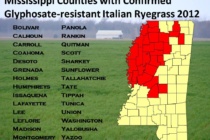
The severity of the glyphosate-resistant (GR) Italian ryegrass problem in Mississippi has varied from year to year. This year has been the worst year since the initial confirmation in 2005, and GR Italian ryegrass is spreading.
For many years, one of the mainstay residual herbicides in soybean weed control systems was metribuzin (Sencor/Lexone). One of the drawbacks to metribuzin use is the sensitivity of some soybean varieties to this herbicide. A research project conducted by Mississippi State University and the University of Arkansas screened some of the modern germplasms available to producers for metribuzin tolerance.
This is a brief review of the many agronomy, breeding, pest management, soil fertility, and water conservation research projects funded by the Mississippi Rice Promotion Board.
The 2011 Mississippi State University Row Crop Short Course was held from December 5 – 7, 2011. Topics covered during the Row Crop Short Course included insect and weed management, fertility management, agronomic aspects of crop production, and a farm
You are invited to the 2012 Delta Ag Expo. The Delta Ag Expo provides farmers and others interested in agriculture an opportunity to see the latest technology in agricultural products, services, and information. You will have the opportunity to view agricultural exhibits and talk with extension and research personnel and get up-to-date information for planning your crop year.
I would like to thank everyone for attending the Rice Short Course. At much request, I have included copies of the presentations made at this short course. Also, I have attached a preliminary copy of the Rice Variety Trial Booklet.
Wheat can be established using various methods, but several management practices can certainly enhance your potential for growing a productive crop this season. Those practices include timely planting, appropriate seeding rates and methods, suitable seedbed preparation and fall weed control.
The reality of weed control in the Midsouth today is that the weed control season is never over. Because of glyphosate-resistant weeds, we are either in the process of killing weeds or we should be thinking about how to kill them.
Farmers really don’t have a proverbial “slow time†anymore but now is a good time to remove any weeds from field borders and edges to prevent seed production.

© 2023 Copyright Mississippi Crops. All Rights reserved.
