Auxin Herbicide Plantback Restrictions
There are a multitude of 2,4-D and dicamba formulations labeled for application to agricultural fields.

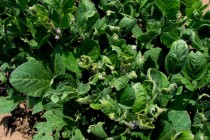
There are a multitude of 2,4-D and dicamba formulations labeled for application to agricultural fields.
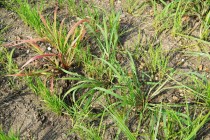
Barnyardgrass is resistant to five herbicide modes of action in rice.
Find attached the agenda for the 42nd Annual Delta Ag Expo to be held in Cleveland, MS on Wednesday, January 21 and Thursday, January 22, 2015. We hope to see you in attendance at the Bolivar County Ag Expo Center.
The 2014 Delta area/Bolivar Co. Rice Meeting will be held at the Bolivar Co. Extension office on December 4, 2014. Mississippi rice producers, industry professionals, and other interested parties are invited to listen to presentations from MSU research and Extension
Described below are the most common nutrient related issues that occur in Mississippi rice production and a few distinctive characteristics to key on when trying to properly identify each issue in the field. Nutrient issues in rice can take on
As more and more of the rice crop starts to head, it is time to start thinking about rice stink bug. We have been sweeping some grass around the Delta for the last few weeks, and the one general comment I will make is that populations have been fairly low in most areas. We have seen fairly high numbers in a couple places, but it was small patches of heading grass in isolated locations.
With most of Mississippi receiving large amounts of rain during early June, opportunities for herbicide applications in soybean have been rare up to this week. Several calls have come in regarding herbicide options in situations where the weather has prevented
We have been getting a lot of questions the last 7 to 10 days about potential injury or problems associated with mixing thrips insecticides with POST herbicides over cotton. This will no doubt be controversial, but we are going to lay it out like we would if you called.
Similar to most years when we have armyworms in wheat, there is the threat of having armyworms in seedling rice. We know of at least one rice field in Mississippi that was sprayed earlier this week. In general, damage from armyworms will not impact rice yields at this time of year unless they are beginning to reduce plant stand. This is especially true in hybrid rice planted at low seeding rates.
Planting progress on the 2014 cotton crop has certainly been more timely than in 2013; however, we still lag somewhat being a “normal” planting window. An issue that seems to be occurring on numerous farms this year is simultaneous cotton
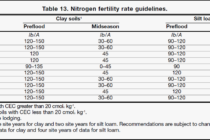
Maintaining nitrogen applied as a pre-flood application is an important topic for rice farmers. Nitrogen can be lost by at least three different methods, two of which are considered to be bad since the N will become unavailable for plant uptake.
A little rice has started to go to flood in Mississippi this week and that means it is time to start thinking about rice water weevil. Overall, the majority of the crop is behind because of all of the rain that we have had across the Delta over the last several weeks. In general, the rice that is currently being flooded was some of the earliest planted. As a result, the early rice has endured a lot of rainfall and adverse conditions.
A substantial number of soybean acres have been reported to be affected by seedling disease. However, the majority of the field seedling issues can be blamed on poor environmental conditions following the planting that occurred around Easter (between April 14 and 19) and some of the residual herbicide products applied.
Before the rice season gets into the full swing, consider several important fungicide application strategies before the mid-season fungicide application. Preventing fungicide-resistance from developing is the first step in managing the issue.
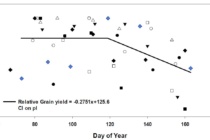
Many people ask why continue mundane planting date research don’t we have enough. Truth is, when talking about items such as planting date, and soil testing data that will be modeled, there is never enough data. The more data you
Dr. Jeff Johnson, Head of the Delta Research and Extension Center, has assigned responsibility for Extension in rice to Dr. Bobby Golden. Dr. Golden will serve in this capacity until a suitable candidate is identified for the Rice Agronomist/Extension Specialist
Supplemental labeling will allow in-season applications of Sharpen to rice in 2014.
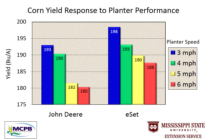
Corn planting can be a hectic time, but it pays to take care of business when planting corn. Here are some keys to a successful start and optimal corn yields.
Just to prove that 2,4-D labels can be confusing, plantback restrictions were listed correctly in the previous post, but formulations were not specified.
With the cold, wet weather, many burndown herbicide applications were delayed. This has led to a multitude of questions on plantback restrictions for 2,4-D and dicamba prior to planting corn and soybeans.
In Mississippi, research indicates that management of medium-grain varieties is similar to that of long-grain varieties.
Annual report of Mississippi Rice Promotion Board is now available online.
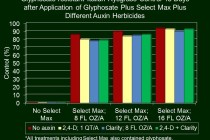
Control of glyphosate-resistant Italian ryegrass was reduced with glyphosate plus Select Max at reduced rates when combined with 2,4-D Ester and/or Clarity.
Attached please find the agenda for the Delta Ag Expo in Cleveland, MS. Make careful note that the dates of the meeting have changed from previous years due to a minor scheduling conflict with the Bolivar County Exposition Center.
Italian ryegrass is a serious weed in wheat production and continues to spread across much of Mississippi. The increasing prevalence of Italian ryegrass in grower fields is compounded by the lack of control from many commonly used herbicides, such as ALS inhibitors and glyphosate.

© 2023 Copyright Mississippi Crops. All Rights reserved.
