Off-target Herbicide Movement to Rice
As rice approaches reproductive growth stages, it is less likely to recover from injury due to off-target herbicide movement.
Mississippi State University will be hosting 5 scout schools this year. We have transitioned over the years to make these trainings much more diverse than insect pest alone. This year we will be including insects, disease, fertility, weed identification, and herbicide systems. There will be numerous hands on displays of insects, weeds, nutrient deficiencies in all major row crops, and fertilizer characteristics. CEU’s Provided: Nutrient Management = 1.5, Integrated Pest Management = 3, Crop Management = 1
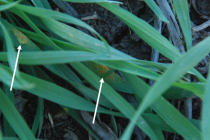
Wheat diseases can be observed in almost any wheat field throughout the season. However, when wheat moves beyond the tillering growth stages scouting for the presence of foliar diseases should be conducted. Many, but not all of the foliar disease encountered in MS can result in a yield loss. But, additional issues encountered in wheat fields can oftentimes be easily confused for foliar diseases.
The previously scheduled Mississippi Soybean Promotion Board seminar dates in Tunica, Verona, and Macon for Wednesday (2/25) and Thursday (2/26) have been CANCELED due to the potential for inclement weather over the next 36 hours. Future dates will be listed on the Mississippi Crop Situation Blog and locations will likely not change. Please stay tuned for further announcements.
Three more opportunities exist for ag-related personnel to attend the Mississippi Soybean Promotion Board sponsored seminar series on nutrition management, nematode sampling and management, and irrigation practices. Meetings are scheduled next week in Tunica (2/25; 9 am), Verona (2/26; 9 am), and Macon (2/26; 2:30 pm).
Stripe rust was detected in wheat in Washington County, MS in the wheat variety trial plots. Wheat fields in MS should be scouted at this time for the presence of stripe rust. Fungicide applications with products in the triazole (DMI) class of fungicides will prevent spread of the disease and in some cases where the disease has occurred and been observed in a wheat field may protect yield.
On February 5th 2015, Mississippi State University will host the third annual Future of Agriculture Graduate Student Competition. The competition will be open to M.S. and Ph.D. students working in production agriculture. Over the last several years, there has been a
Find attached the agenda for the 42nd Annual Delta Ag Expo to be held in Cleveland, MS on Wednesday, January 21 and Thursday, January 22, 2015. We hope to see you in attendance at the Bolivar County Ag Expo Center.
Green stem disorder can be a sporadic issue from year-to-year and field-to-field. In the current blog post a survey is attached whereby individuals can answer five basic questions on their thoughts and opinions regarding the presence of green stem.
Disease severity was rated for each of the OVT soybean entries at all locations planted during 2014. Varieties were rated using a 0-9 scale where 0=no disease and 9=severe disease symptoms. The attachments on this blog post contain the Maturity Group V early and late entries.
Disease severity was rated for each of the OVT soybean entries at all locations planted during 2014. Varieties were rated using a 0-9 scale where 0=no disease and 9=severe disease symptoms. The attachments on this blog post contain the Maturity Group IV and early and late entries. The MG V entries will be along shortly.
Disease severity was rated for each of the OVT soybean entries at all locations planted during 2014. Varieties were rated using a 0-9 scale where 0=no disease and 9=severe disease symptoms. The attachments on this blog post contain the Maturity Group IV and V Conventional and LibertyLink entries. The MG IV and V RR entries will be along shortly.
The 2014 Delta area/Bolivar Co. Rice Meeting will be held at the Bolivar Co. Extension office on December 4, 2014. Mississippi rice producers, industry professionals, and other interested parties are invited to listen to presentations from MSU research and Extension
Boll rot appeared to be a common occurrence in numerous cotton fields at the end of the 2014 season. However, not all boll rot can be attributed to bacterial blight, especially in situations where the disease was not observed prior to harvest. Secondary fungal infection can ultimately obscure the observable boll symptoms associated with bacterial blight. Keep this in mind when scouting fields at the end of the season as bacterial blight boll lesions can oftentimes be obscured by secondary fungal invaders.
Variety trials were rated at the NMREC to determine the sensitivity of MG IV and V soybean varieties to frogeye leaf spot as well as Cercospora blight. Varieties were using a 0-9 scale where 0=no disease and 9=severe disease symptoms. Yield data will be available in a few weeks as this post only contains the analyzed rating values for the varieties contained in the trial at Verona.
Foliar diseases of soybean continue to be observed throughout the MS soybean production area. At present, no soybean rust has been detected in MS; however, Cercospora blight and frogeye leaf spot as well as several pod diseases (topic of the next blog post) are being observed in numerous soybean fields.
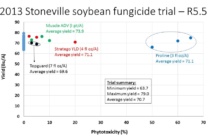
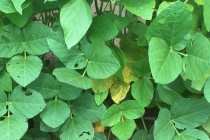
Phytotoxicity, associated with the application of some specific foliar fungicide products, has been observed in numerous commercial soybean fields again this season. Keep in mind that the symptoms associated with fungicide phytotoxicity will appear quite similar to sudden death syndrome (SDS). However, SDS only occurs in light soil classes. When scouting fields, keep in mind that an entire field with SDS-like symptoms might be the result of fungicide phytotoxicity, thus not a disease after all.
Diseases of soybean continue to be observed throughout the MS production system. At present, soybean rust has not been detected within MS; however, we continue to scout for the presence of rust, as well as additional diseases of economic importance throughout sentinel plots as well as commercial soybean fields. Frogeye leaf spot, sudden death syndrome, stem canker, and aerial blight continue to be hot topics for most soybean farmers.
Soybean diseases continue to be observed throughout MS. Brown spot, aerial web blight, frogeye leaf spot, Cercospora blight are the predominant foliar diseases observed at present. In addition, several root diseases are becoming apparent from fields across the state.
Southern corn rust continues to be observed throughout MS. We continue to receive calls regarding late fungicide applications (> R4/R5) to reduce yield losses attributed to southern rust. Numerous myths regarding the disease have been widely spread throughout the MS corn production area including death of a corn plant in as fast as 7 days following southern rust infection and lodging as a result of heavy southern rust infection.
The North Mississippi Research and Extension Center’s Agronomic Row Crops Field Day on Thursday, August 7 will present the latest research to the area’s row-crop farmers and consultants. The field day will be from 8 a.m. to 1:30 p.m. at the Lee County Agri-Center Magnolia Conference Center on Highway 145 South in Verona.
Described below are the most common nutrient related issues that occur in Mississippi rice production and a few distinctive characteristics to key on when trying to properly identify each issue in the field. Nutrient issues in rice can take on
As more and more of the rice crop starts to head, it is time to start thinking about rice stink bug. We have been sweeping some grass around the Delta for the last few weeks, and the one general comment I will make is that populations have been fairly low in most areas. We have seen fairly high numbers in a couple places, but it was small patches of heading grass in isolated locations.
Last week’s weather pattern in the Delta provided near perfect conditions for rice blast (Pyricularia grisea) to occur. Rice blast is generally categorized by the plant part infected (e.g., leaf, neck, panicle). Blast favors mild humid weather, frequent rainfall, and
Foliar diseases of soybean continue to be observed throughout the state. At present, no soybean rust has been detected in Mississippi. However, aerial web blight, downy mildew, frogeye leaf spot, and target spot have all been observed in light to severe situations depending on field location.